Suno vs Udio 2026: Which AI Music Tool Is Safe to Release Commercially
TL;DR
After a sustained Suno practice, here's the honest 2026 verdict on Suno vs Udio — and the licensing change that makes one of them risky to release commercially right now.

Decide which AI music tool you can safely release and monetize in 2026 — and why the licensing terms matter more than the audio.
TL;DR — For commercial release in June 2026, Suno is the safer choice. Both tools settled with Universal and Warner in late 2025, but they diverged on what happens next. Suno still lets paid subscribers download tracks and distribute them to Spotify, Apple Music, and sync libraries — with commercial rights that survive cancellation. Udio, under its UMG deal, moved to a "walled garden": you can stream creations inside Udio but export and external distribution are restricted on the licensed platform. If your goal is releasing and selling music, that single difference decides it. The caveat: neither company grants you copyright the law may not give you, and Sony's case is still unsettled. Verify current terms before you distribute.
Most of this comparison comes from running both tools daily across genres, not from reading marketing pages. But in 2026 the deciding factor isn't audio quality anymore — it's what each platform's terms let you legally do with the file after you make it. That's the part most comparisons skip, and it's the part that costs you a takedown.
What changed in 2026 that makes this comparison different?
For two years the question was "which sounds better." In 2026 it became "which can I actually release."
In June 2024, Universal, Warner, and Sony sued both Suno and Udio over training data. By late 2025 the landscape split:
- Udio settled with UMG (late October 2025), then Warner (November 2025).
- Suno settled with Warner (November 25, 2025) and partnered with them on licensed models.
- Sony has settled with neither. Its fair-use cases — against Suno in Massachusetts and Udio in the Southern District of New York — are expected to produce a pivotal ruling in summer 2026.
The settlements didn't just clear legal air. They reshaped the products. Udio's UMG deal introduced a walled garden. Suno's Warner deal kept downloads but added caps and a roadmap to fully licensed models that will replace the current ones. Read the Music Industry AI Lawsuits Tracker for live status before you make a release decision — this moves monthly.
Can you legally sell music made with Suno or Udio?
This is the question that matters, and the answer has two layers most articles collapse into one.
Layer one — platform permission. Both platforms grant paid subscribers commercial-use rights. With Suno Pro or Premier, you can monetize tracks through streaming, downloads, and sync, and Suno doesn't take a revenue share. Udio's paid plan grants non-exclusive, perpetual, worldwide commercial rights with no attribution required. So on permission alone, both say yes — if you're paying.
Layer two — copyright ownership. This is where it gets honest. Under Suno's revised terms following the Warner partnership, Suno removed the language of "ownership" for users — Suno is treated as the author of the audio, and you receive a perpetual license to exploit it commercially. Separately, the U.S. Copyright Office position is that purely AI-generated work may not be copyrightable at all. So you can sell it and keep the revenue, but you may not be able to stop someone else from using it. That's a licence to exploit, not a copyright you own.
I don't say that to scare you off — I release AI-assisted music. I say it because the difference between "I can monetize this" and "I own this exclusively" is the difference between a clean catalog and a dispute. If exclusivity matters (sync deals, brand exclusives), add human authorship: real instrumentation, lyrics you wrote, arrangement and mix work. For deeper licensing nuance, see the 2026 Suno Legal Guide and Udio's terms breakdown, then confirm against each platform's live terms.
Why is Udio's "walled garden" the dealbreaker for release?
This is the hook nobody leads with, and it's the whole decision.
As part of the UMG settlement (announced October 29, 2025), Udio's licensed platform — in staged rollout through the first half of 2026 — moved to a walled-garden model. You can create and stream your tracks inside Udio and share them within its environment. What you can't reliably do is export the file and distribute it to outside platforms (DSPs like Spotify, sync libraries, YouTube, your own store).
When Udio first shuttered downloads at settlement, the backlash was loud enough that the company opened a 48-hour window (starting Monday, November 3, 2025) for users to download existing songs — with tracks made before the agreement covered by the older terms that granted download rights. That tells you the direction of travel: on the new licensed Udio, streaming-inside is the model, and external distribution is the exception, not the default.
For a hobbyist who wants to make and share tracks, that's fine. For anyone whose plan is "release this and earn from it on Spotify," a tool you can't export from is a non-starter — no matter how good it sounds. See Chartlex's walled-garden explainer and the Udio download-window report for the specifics.
How do Suno and Udio compare on quality, pricing, and rights?
| Factor | Suno (v5 / v4.5) | Udio (2026 licensed) |
|---|---|---|
| Commercial download + DSP distribution | Yes, on paid plans (MP3/WAV), under monthly download caps | Restricted on licensed platform — walled garden, stream-inside model |
| Rights survive cancellation | Yes — paid-plan tracks keep their commercial license | Non-exclusive perpetual license; export is the constraint, not the licence |
| Audio quality | v5: strong on acoustic, pop, hip-hop; natural breaths/phrasing | Historically excellent fidelity and realism; very competitive |
| Vocals | More natural phrasing in v5; reliable across genres | Strong, expressive vocals — a long-standing Udio strength |
| Section editing / control | Suno Studio (Premier): timeline multi-track, stems, MIDI export, BPM/pitch | Strong section/prompt control inside platform |
| Stems | Yes — Premier via Suno Studio (MP3, WAV, tempo-locked WAV, MIDI) | Available historically; subject to walled-garden export limits |
| Free tier | 50 credits/day, v4.5-All, non-commercial, playback/share | Free tier exists; monetization requires paid plan |
| Paid pricing | Pro $10/mo (2,500 credits), Premier $30/mo (10,000 credits + Studio) | Pro $30/mo (6,000 credits) |
| Settlement status | Settled Warner + UMG; Sony unsettled | Settled UMG + Warner; Sony unsettled |
Two honest notes on this table. First, Udio's audio has never been the problem — it's genuinely good, and for in-platform creation it competes hard. Second, "monthly download caps" on Suno are real but the exact numbers weren't published as of early 2026; Premier's 10,000 credits and download packs cover any serious release schedule I've run. Pricing per Suno's pricing page and Udio pricing coverage.
Which one should you actually use in 2026?
Pick by goal, not by hype.
- You want to release and monetize on Spotify / Apple / sync → Suno. It's the tool that still produces a downloadable file you can distribute, with a commercial license that survives cancellation. This is most people reading this.
- You want the absolute best in-platform creation experience and don't need to export → Udio is fair game. The walled garden isn't a flaw if you're not leaving the garden.
- You want section-level control, stems, and a DAW-style workflow → Suno Premier + Suno Studio. Multi-track timeline, stem export, MIDI, BPM and pitch control. This is what moved me from "generate and pray" to actual production.
My setup: Suno Premier for production and release, because I distribute. I keep an eye on Udio's licensed rollout because a fully-licensed catalog you can clear for sync is valuable even inside a walled garden — that's a different business than DSP streaming.
If you want the full prompting methodology behind getting release-grade output, I wrote the Suno prompt engineering guide. Music is one lane of a larger creator stack — see how it composes in the best AI superpowers stack for 2026, and pair your tracks with cover art using the best AI image generators of 2026.
What about the affiliate and creator programs — named honestly?
Yes, Suno runs creator-facing programs, and I'll name the angle plainly: Suno has a referral/partner program. When someone signs up through your link and creates their first 10 songs, both of you earn free credits (250 per referral, up to 2,500). There's also a structured short-form creator/ambassador track for people producing content consistently.
I'm not posting an affiliate link in this article. If I did, I'd tell you it was one. The reason I recommend Suno here is the walled-garden problem on Udio's side, not a payout — the recommendation would be identical with zero affiliate relationship. That's the only way a comparison is worth reading. If you want to build a creator practice around this, GenCreator is the framework I use to turn tools like Suno into a repeatable output system.
Evolve Your Creative Workflow: Build Your CoE
If you are ready to stop chasing individual tools and start building a compounding system, explore the GenCreator Platform.
GenCreator adapts the six-pillar AI Center of Excellence (CoE) pattern into a practical operating system for solo builders and creators. Turn your tool stack into an automated personal engine.
👉 Start building your personal AI CoE at GenCreator.ai
FAQ
Is Suno or Udio safer to release music commercially in 2026? Suno, for most creators. Both grant paid-plan commercial rights, but Suno still lets you download and distribute to outside platforms, while Udio's licensed 2026 platform restricts export under a walled-garden model. If your goal is releasing on DSPs, Suno is the practical choice. Verify current terms before distributing.
Do I actually own music I make with Suno? Not as copyright in the traditional sense. After the Warner partnership, Suno's terms treat Suno as the author and grant you a perpetual commercial license to exploit the track. You can sell it and keep the revenue, but purely AI-generated work may not be copyrightable in the U.S., which limits exclusivity. Add human authorship if you need to defend ownership.
Can I still download my songs from Udio? On older pre-settlement tracks, generally yes under the prior terms. On the new licensed Udio platform rolling out through 2026, the model moves toward stream-inside with restricted export. Udio opened a temporary 48-hour download window at settlement after user backlash, which signals the direction. Check Udio's current terms before relying on downloads.
Is the Suno and Udio lawsuit over? Partly. Both settled with Universal and Warner in late 2025. Sony Music has settled with neither — its fair-use cases against Suno (Massachusetts) and Udio (Southern District of New York) are expected to produce a key ruling in summer 2026. The legal picture is not fully settled; treat any "it's all clear now" claim with caution.
Will the current Suno and Udio models be replaced? Likely yes. Both companies are building new, fully licensed models trained on rights-holder catalogs. Suno has signaled that current models will be terminated when the licensed models launch in 2026, with monthly download caps in place. Plan your catalog knowing the engine underneath may change.
What's the cheapest way to release commercially? Suno Pro at $10/month grants commercial rights and downloads with 2,500 monthly credits — enough for roughly 500 songs. That's the lowest-cost path to a legally-permitted, distributable file in 2026. Premier ($30/month) adds Suno Studio, stems, and MIDI for production work.
The tools will keep changing — models get deprecated, terms get rewritten, Sony's ruling lands this summer. What doesn't change is the discipline: read the live terms before you distribute, add human authorship when exclusivity matters, and pick the tool that lets you actually ship. In 2026, for commercial release, that's Suno. Start with the prompting guide and build from there. More frameworks at frankx.ai.
Sources: Suno commercial rights · Suno pricing · Suno legal guide 2026 · Udio terms 2026 · Udio walled garden · Udio download window · Lawsuit tracker

Read on FrankX.AI — AI Architecture, Music & Creator Intelligence
Stay in the intelligence loop
Field notes on AI systems, production patterns, and builder strategy.
Continue Reading

Best Cheap AI Music Generator 2026: Free Tiers and Commercial Rights Compared
A creator compares the cheapest AI music generators in 2026 — Suno, Udio, AIVA, Riffusion, Soundraw, Mubert — on price, free-tier limits, and commercial rights.
Read article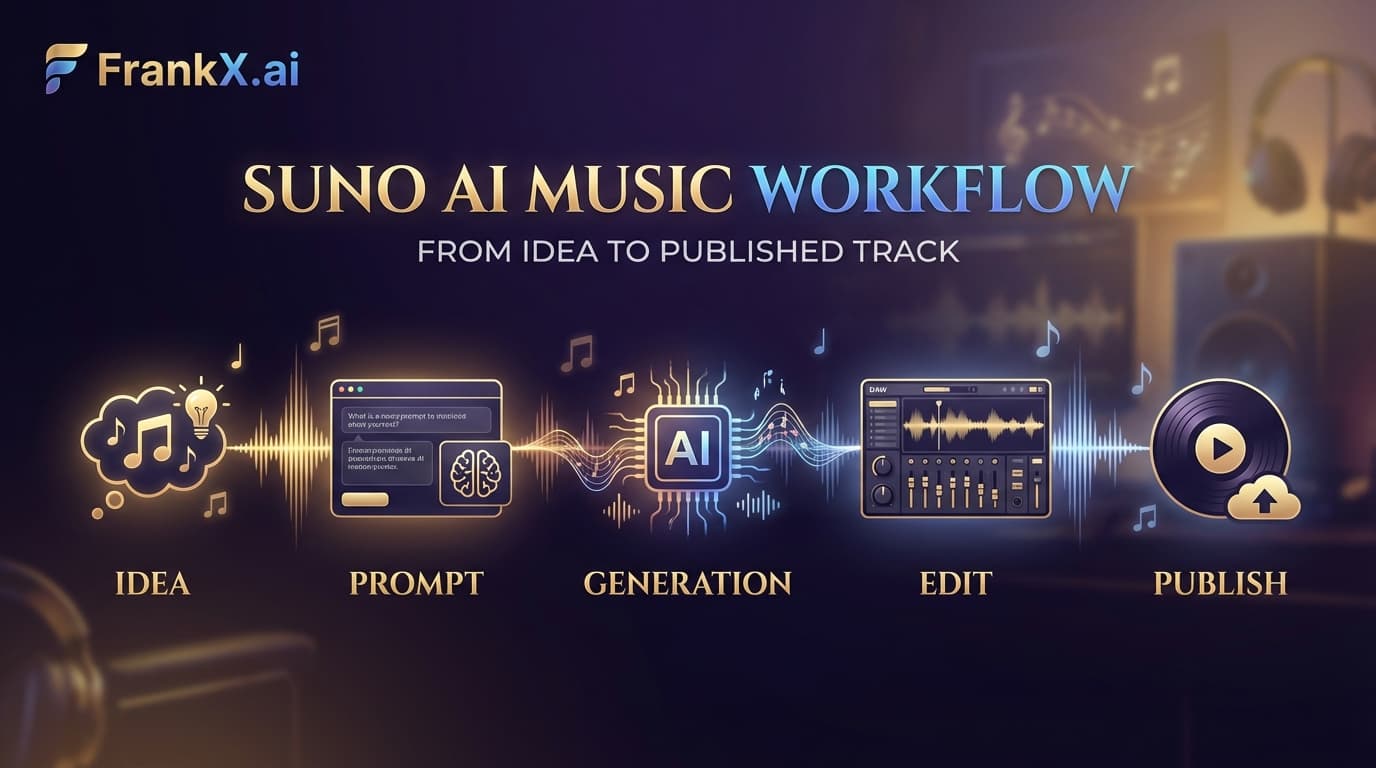
How to Use Suno AI for Professional Music Production
Move beyond 'hit and hope' generation. A systematic workflow for using Suno AI to produce radio-ready tracks, from emotion mapping to stem mixing.
Read article
Create Music Without Musical Training: The Suno AI Music Creation Workshop
Transform your ideas into cinematic soundscapes, meditation-inspired music, and motivation anthems using AI. Learn the 5-Layer Prompt Architecture and aesthetic tuning choices for expressive audio.
Read article