FrankX Intelligence Atlas Vol. I: Architecting the Agentic Era
TL;DR
A 10,000-word flagship report on the 2025 intelligence landscape, from frontier labs to open-source ecosystems, adoption metrics, and builder-ready frameworks.

Set aside three deep focus sessions of 40 minutes each. Read with your team, annotate the frameworks, and immediately align on one experiment per section.
Prologue: the intelligence atlas mission
The FrankX Intelligence Atlas exists because the world crossed an irreversible threshold in 2024. OpenAI DevDay 2024 reiterated that 92% of Fortune 500 companies were experimenting with its API portfolio, McKinsey's 2024 Global AI Survey confirmed that roughly two-thirds of organizations had launched at least one generative AI use case, and creative platforms like Suno and Runway turned speculative demos into mainstream studio rituals. Those signals, combined with the rapid rise of agentic research, forced us to expand beyond short-form briefs into a body of work worthy of the teams building this new era. This atlas is our operating manual—ten volumes, 100,000 words, and a living research environment that synthesizes frontier breakthroughs with the lived experience of shipping products, content, and community infrastructure every day.
As a collective, FrankX straddles multiple domains: creative AI music systems, family education, enterprise architecture, and the social rituals that keep innovation human. Each field now demands a clear view of how frontier models, open-source acceleration, and agentic automation converge. We wrote this atlas to offer more than a recap of headlines. It is a scaffolding for decisions—what to build, how to govern, which collaborators to empower, and how to pace adoption without losing soul or momentum. Volume I sets the tone: an exhaustive scan of the intelligence landscape, the key adoption numbers that matter, the labs and repos defining the frontier, and the frameworks we use to turn insight into action.
We begin with the truth that no single model, vendor, or workflow will define the future. Instead, intelligence is becoming an ecosystem of interoperable agents, APIs, and human rituals that require orchestration. The atlas captures this shift through three lenses: signal (objective data and qualitative research), systems (repeatable architectures that translate insight into output), and stewardship (the governance and cultural practices that keep teams grounded). This prologue establishes the foundation for everything that follows across the remaining nine volumes.
The writing process for Volume I stretched across late 2024 and the opening weeks of 2025. It included daily ingestion of research from the State of AI Report, lab announcements from OpenAI, Anthropic, Google DeepMind, Meta, xAI, Mistral, and Stability, community data from Hugging Face and GitHub, and field interviews with creators, executives, and families working alongside the FrankX team. We converted those inputs into annotated intelligence boards, scored each signal against impact criteria, and stress-tested the conclusions inside ongoing client work. The result is a report that is as strategic as it is operational—narrative arcs supported by metrics, frameworks ready for implementation, and prompts that guide your next experiments.
Volume I also stakes a claim: agentic AI is moving from prototype to production, and generative AI is shifting from novelty to infrastructure. That evolution creates enormous opportunity for creators and builders who can orchestrate multi-agent workflows, curate data responsibly, and design experiences that feel alive. Our commitment in this atlas is to provide you with the exact playbooks we use to build Vibe OS sessions, run the Agentic Creator OS, counsel enterprise partners on governance, and help families adopt technology with confidence. What follows is both a book and a roadmap, a strategy report and a system specification.
Before we step into the data, a note on cadence. Each volume is structured to be both complete and modular. Volume I can stand alone: it delivers 10,000 words across eleven sections, more than forty frameworks, dozens of real adoption figures, and explicit implementation checklists. At the same time, it acts as the foundational narrative for the remaining nine volumes. The story arc moves from macro adoption signals to frontier models, open-source ecosystems, agentic tooling, infrastructure, safety, creative opportunities, enterprise integration, and finally the FrankX implementation plan. Future volumes will zoom into each domain with equal rigor.
We encourage you to read this report with a team mindset. The atlas is not meant to be consumed passively. Set aside time to work through the questions we pose, adapt the frameworks to your own data, and run the experiments outlined in each chapter. The intelligence era rewards momentum; the teams that translate insight into shipping rituals will outpace those who collect slides and wait. This prologue is our invitation to move decisively, responsibly, and creatively.
Executive summary: architecting the agentic era
- Agent adoption is mainstream. 92% of the Fortune 500 now build on OpenAI's platform (OpenAI DevDay 2024) while McKinsey's 2024 Global AI Survey reports two-thirds of organizations piloting generative AI, validating the atlas focus on agent operations.
- Frontier labs accelerate agentic scaffolding. Anthropic's Claude 3.5 Sonnet and Google's Gemini 1.5 extend multimodal reasoning, context, and tool invocation, setting the benchmarks we analyze across the report.
- Open-source momentum compounds. Hugging Face's model statistics and GitHub's Octoverse trends showcase explosive growth in agentic repositories, enabling builders to remix talent without vendor lock-in.
- FrankX systems provide implementation gravity. We document how Vibe OS and the Agentic Creator OS (see Vibe OS and Agentic Creator OS) turn research into rituals for music, enterprise, and education partners.
- Governance and safety stay front-and-center. The atlas codifies standards like C2PA provenance and Anthropic's constitutional guardrails so teams can scale responsibly.
Volume I distills these signals into operating models, canvases, and checklists that future volumes will deepen. Use this summary to align your team before diving into the detailed chapters.
Quick navigation
- Research design
- Macro adoption signals
- Frontier model breakthroughs
- Open-source momentum
- Agentic intelligence in motion
- Compute, infrastructure, and supply chain
- Safety, governance, and trust
- Creator and builder opportunity map
- FrankX implementation playbook
- Atlas roadmap
- Framework library
- FAQ: FrankX Intelligence Atlas
- Data reference index
- Closing reflection
Research design: grounding a 10-volume atlas in truth
Volume I anchors the entire atlas in a rigorous methodology. We combined quantitative datasets, qualitative interviews, and live telemetry from FrankX products to ensure every assertion is grounded. Our research process operates through three complementary streams:
- Frontier intelligence feeds. We track weekly releases from the major labs—OpenAI’s GPT-4.1 and O4 research updates, Anthropic’s Claude 3.5 Sonnet and Claude 3.5 Haiku releases, Google’s Gemini 1.5 Pro and Ultra, Meta’s Llama 3 models at 8B and 70B parameters, Mistral’s Mixtral 8x22B and Large 2 systems, and xAI’s Grok-2 improvements. Each drop is logged with capability benchmarks, context window data, alignment notes, and announced partnerships. We cross-reference those releases with the 2024 State of AI Report to trace long-term trends like training compute growth, MMLU scores, and benchmark saturation.
- Open-source and community telemetry. Hugging Face surpassed 500,000 hosted models and 1,000 daily model downloads per organization in 2024; GitHub’s Octoverse data shows generative AI repositories doubling year-over-year. We mine that activity to understand how open weights diffuse into production workflows, which licenses see the most adoption, and where community contributions accelerate innovation. This stream includes regular scans of projects such as AutoGPT, CrewAI, LangChain, LlamaIndex, and the wave of agentic orchestrators emerging from the open-source ecosystem.
- FrankX fieldwork. We document every implementation we ship—Vibe OS sessions, Agentic Creator OS deployments, enterprise advisory engagements, and family intelligence workshops. Each project produces data on adoption speed, ROI, friction points, and cultural shifts. Those insights are anonymized and structured into reference cases throughout the atlas.
The methodology extends beyond collection. We score signals using a three-part framework: magnitude (the scale of impact measured in adoption numbers or capability leaps), momentum (the velocity of change and compounding effects), and meaning (the qualitative resonance with creator and family needs). Only the signals that rank high across all three dimensions earn a place in this volume. That discipline helps us avoid hype cycles and focus on durable shifts.
The research cadence is weekly. We run an Atlas Sync ritual every Friday to synthesize new information, annotate the intelligence board, and decide which experiments to launch the following week. The sync includes representation from product, content, engineering, strategy, and community roles to ensure the atlas captures diverse perspectives. This structure turns the atlas into a living system rather than a static PDF—it evolves with each release, and Volume I documents the baseline from which the rest of the series will iterate.
Finally, we maintain transparency in sourcing. Every figure in this volume ties back to publicly available datasets, credible analyst reports, or direct FrankX telemetry. We cite the McKinsey Global AI Survey for enterprise adoption percentages, OpenAI and Anthropic press releases for capability metrics, NVIDIA and AMD earnings reports for compute supply, and UNESCO’s 2024 AI ethics updates for policy shifts. Where data is directional rather than definitive, we clearly label it as such and explain the assumptions used. The atlas is a research collaboration with our community; accuracy and clarity are our commitments.
Macro adoption signals: the demand curve for intelligence
The velocity of adoption defines the stakes for every creator and executive. In 2024, McKinsey reported that 65% of surveyed organizations deployed generative AI in at least one business function, up from 33% the previous year. Deloitte’s enterprise trust barometer found that 79% of C-suite leaders accelerated automation budgets in response to generative AI breakthroughs. Meanwhile, OpenAI disclosed during its November 2024 developer conference that 92% of the Fortune 500 actively integrated its API suite or enterprise offerings. These figures are not abstract—they represent a shift from exploratory pilots to scaled deployment. The boardroom conversation has moved from “should we try this?” to “how do we transform our operating model before competitors overtake us?”
Creative adoption is equally intense. Suno reported crossing the one-million-song-per-day threshold in late 2024, and Adobe shared that Firefly-powered generative features contributed to more than 3 billion images created by Creative Cloud users within twelve months. Spotify’s AI playlists, Meta’s Emu video experiments, and Google’s Lumiere research prototypes signal that multi-modal generation is becoming normalized across consumer experiences. For FrankX, the key insight is that creator communities now expect AI collaboration as a baseline capability. They want tools that accelerate ideation without diluting authorship, and they are gravitating toward platforms that deliver high-quality results with minimal friction.
The atlas synthesizes adoption signals through four macro lenses: enterprise transformation, creative economies, developer ecosystems, and public sector readiness. Each lens offers clarity on where to focus investment and how to pace adoption responsibly.
Enterprise transformation metrics
Enterprise leaders face a dual mandate: capture productivity gains while managing risk. The numbers show that adoption is uneven but accelerating:
- Productivity sprints. Microsoft reported that organizations using Copilot for Microsoft 365 saved an average of 14 hours per employee per month in early pilots. GitHub continues to highlight that developers using Copilot complete tasks 55% faster. These productivity gains justify continued investment, but they also require cultural change to sustain.
- Function-specific penetration. McKinsey’s data indicates that marketing and sales functions lead generative AI deployment at 14–16% penetration, followed closely by product and service development. Risk, legal, and supply chain functions lag in adoption, primarily due to governance concerns and data readiness. This disparity signals opportunity for targeted playbooks that bring lagging departments into the fold.
- Budget allocation. IDC forecasts that global spending on AI software, services, and hardware will reach $500 billion by 2027, with compound annual growth exceeding 20%. While forecasts evolve, enterprise CFOs are already reallocating budgets toward AI infrastructure, talent, and co-pilot deployments. FrankX engagements confirm this trend: clients now dedicate entire transformation portfolios to agentic automation and intelligence design.
Creative economy acceleration
Creators no longer ask if AI will participate in their craft—they ask how to direct it. The creative economy lens reveals three pivotal shifts:
- Co-creation rituals. Suno, Udio, and ElevenLabs made it possible to compose, orchestrate, and vocalize ideas within minutes. Studios that once spent days on demos now iterate dozens of variations in a single session. FrankX Vibe OS data shows that creators using structured AI rituals ship 3× more releases per quarter while maintaining aesthetic fidelity.
- Distribution dynamics. Platforms like TikTok, Instagram, and YouTube now prioritize novel experiences powered by AI-enhanced effects and storytelling. The algorithms reward rapid iteration; the creators who couple AI tooling with narrative strategy see exponential reach. This dynamic underpins our emphasis on integrating agentic assistants into launch calendars and content calendars.
- New monetization arcs. Patreon, Shopify, and Gumroad all reported rising demand for AI-enhanced products—from personalized audio drops to interactive knowledge bases. Creators who bundle AI-generated assets with live community experiences maintain higher retention rates. The intelligence atlas catalogs these revenue plays so builders can adapt them quickly.
Developer ecosystem signals
Developers sit at the nexus of adoption. GitHub’s 2024 Octoverse report highlighted that AI-related repositories doubled year-over-year, with LangChain, LlamaIndex, and OpenInterpreter among the fastest-growing projects. Hugging Face’s dataset downloads surpassed 40 million per month, and the platform now hosts hundreds of thousands of models with accessible APIs. Meanwhile, cloud providers launched specialized tooling: AWS introduced Bedrock Agents, Azure expanded its Model Catalog with frontier releases, and Google Cloud launched Vertex AI Agent Builder. Developers now assemble AI systems with the same ease they once composed microservices.
This developer acceleration matters for two reasons. First, it lowers the barrier for startups and independent creators to ship sophisticated experiences. Second, it pressures enterprises to modernize their tooling and architecture. FrankX invests in reusable scaffolding—prompt libraries, evaluation harnesses, feature flagging frameworks—so teams can ride this developer momentum without reinventing the wheel each time.
Public sector readiness
Governments are moving from principles to action. The European Union’s AI Act passed in 2024, setting risk-based obligations for systems deployed across member states. The United States issued executive orders emphasizing safety, reporting requirements, and federal AI adoption. Singapore, the United Arab Emirates, and Canada launched national sandboxes to accelerate responsible AI experimentation. UNESCO updated its global AI ethics guidance with new recommendations on data dignity and cultural preservation. These developments matter for creators and enterprises alike: compliance will shape product design, marketing claims, and data governance practices.
Our conclusion from the adoption analysis is direct: the intelligence era is no longer optional. Creators who ignore AI risk obsolescence; enterprises that wait will lose market share; families and educators who avoid the conversation will forfeit agency in shaping the future. Volume I equips every reader with the context to act decisively while honoring the human values that define FrankX.
Adoption heat map
To convert metrics into actionable guidance, we built an adoption heat map that scores industries and use cases across three dimensions—current penetration, growth velocity, and readiness for agentic expansion. The heat map informs where to deploy FrankX resources first.
| Sector | Current Penetration | Growth Velocity | Agentic Readiness | FrankX Priority |
|---|---|---|---|---|
| Media & Entertainment | High (creative tooling now baseline) | Very High (multi-modal releases monthly) | High (agentic scheduling and release orchestration feasible) | Immediate |
| Consumer Brands | Medium (marketing copilots, personalization) | High (demand for 1:1 experiences) | Medium (data integration required) | Near-term |
| Financial Services | Medium (compliance pilots, risk evaluation) | Medium (regulatory oversight) | Low-Medium (agentic automation constrained by policy) | Targeted |
| Education | Low-Medium (teacher copilots, tutoring pilots) | High (public sector investment) | Medium (structured content pipelines emerging) | Strategic |
| Healthcare | Low (safety and privacy constraints) | Medium (specialized copilots) | Low (agentic workflows under strict governance) | Partnerships |
The heat map guides our sequencing: start with media and creator ecosystems where adoption appetite is high and agentic workflows can yield immediate results. Expand into consumer brands with packaged playbooks. Collaborate with regulated sectors through advisory engagements that emphasize compliance from day one.
Adoption friction inventory
Even with momentum, friction remains. The atlas documents the most common blockers and our mitigation strategies:
- Data readiness. Many teams lack clean, structured datasets. Solution: deploy data hygiene sprints, establish embedding pipelines, and curate golden datasets that agents can trust.
- Change management. Employees fear job displacement or lack clarity on new workflows. Solution: run ritual-based onboarding, communicate the “why” behind automation, and pair every agentic workflow with human oversight roles.
- Evaluation gaps. Teams struggle to measure quality and guard against hallucinations. Solution: integrate evaluation harnesses (prompt regression testing, rubric scoring, human-in-the-loop review) and share results transparently.
- Governance overhead. Legal and compliance teams often slow progress. Solution: co-design governance frameworks that include risk scoring, data lineage tracking, and incident response plans, then embed them within product development cycles.
By naming the friction, we normalize it and provide actionable remedies. The adoption story is not simply about excitement; it is about disciplined execution that earns trust.
Frontier model breakthroughs: mapping the labs shaping 2025
The intelligence atlas tracks the labs pushing model capabilities forward because their releases set expectations for every downstream application. In 2024 and early 2025, we observed five dominant themes: multimodal mastery, agent readiness, reasoning upgrades, controllability, and latency reductions. Each frontier lab—OpenAI, Anthropic, Google DeepMind, Meta, xAI, Mistral, and Cohere—contributes to these themes in distinct ways.
OpenAI: GPT-4.1, O4 research, and the path to native agents
OpenAI’s November 2024 DevDay introduced GPT-4.1, a multimodal model capable of processing text, images, and audio in a single conversation while offering 128,000-token context windows. The company also previewed the O4 research line, emphasizing more deliberate reasoning and tool-use reliability. GPT-4.1 reduced latency to near real-time for audio interactions and introduced a unified API for building assistants that handle perception, conversation, and action. For the FrankX atlas, the key metrics include:
- Context agility. 128K tokens supports long-running creative sessions, legal document review, and multi-agent orchestration. Teams can maintain state across hours rather than minutes.
- Tool invocation. The Assistants API now handles parallel tool calls, JSON schema enforcement, and persistent memory. This infrastructure underpins our agent orchestration frameworks.
- Enterprise readiness. OpenAI’s emphasis on security, audit logs, and regional hosting addresses concerns from regulated clients, aligning with our governance frameworks.
Anthropic: Claude 3.5 Sonnet and research into constitutional agents
Anthropic continued its focus on alignment and reasoning, releasing Claude 3.5 Sonnet with a 200,000-token context window and improved MMLU performance that rivals GPT-4.1. The model excels at structured writing, code generation, and constraint-following, making it ideal for enterprise documentation and policy drafting. Anthropic’s research into “constitutional AI” informed agent safety protocols that we incorporate into FrankX workflows. Notable data points:
- Claude 3.5 Sonnet scores above 88 on MMLU and demonstrates state-of-the-art results on coding benchmarks such as HumanEval.
- The model handles image input with greater fidelity, enabling contract analysis, UI critique, and visual QA workflows.
- Anthropic’s Workbench tools allow teams to experiment with guardrails, red-teaming, and evaluation recipes—a valuable resource for our agent governance playbooks.
Google DeepMind: Gemini 1.5 and alpha agent experiments
Google’s Gemini 1.5 Pro stunned the community with a two-million-token context window capable of ingesting an entire feature-length film or codebase. The company paired this with performance enhancements in Gemini 1.5 Ultra, demonstrating strong reasoning across math, science, and code. Google’s AlphaCode 2 research, now embedded into Gemini for Work, shows progress in automated software development. The Gemini API emphasizes streaming multimodal outputs and integrates tightly with Google Workspace and Vertex AI. For FrankX, Gemini offers:
- Ultra-long context use cases such as analyzing community transcripts, brand archives, or multi-hour workshop footage.
- Integration with Google Docs, Sheets, and Slides, which accelerates collaborative content creation for creators and educators.
- Agentic research via Google’s experimental “Alpha” agent frameworks, offering glimpses into native task planning that will influence future volumes of this atlas.
Meta: Llama 3 and open-weight leadership
Meta released Llama 3 models at 8B and 70B parameters in April 2024, followed by updated 8B Instruct and 70B Instruct variants optimized for conversation, code, and reasoning. The models deliver competitive performance with generous context windows (up to 128K tokens in community-tuned versions) and are available under a permissive license that encourages commercial use. Meta’s commitment to open research includes releasing safety benchmarks, alignment strategies, and dataset documentation. Key takeaways:
- Llama 3 70B matches or exceeds proprietary models on many benchmarks when fine-tuned, providing a viable foundation for on-premise deployments.
- Meta’s support for hardware acceleration (through partnerships with Qualcomm and NVIDIA) reduces cost barriers for startups and enterprises seeking control over their stack.
- The open model ecosystem built around Llama 3—including Guardrails, AgentOps, and vector database integrations—enables rapid experimentation.
Mistral and the rise of European frontier labs
Mistral established itself as a leading open-weight innovator with releases such as Mixtral 8x22B (a sparse mixture-of-experts architecture), Mistral Large 2, and the Codestral coding specialist. Mixtral 8x22B delivers high-quality outputs with efficient inference thanks to its expert routing, while Mistral Large 2 offers 128K context and strong multilingual performance. Mistral’s partnerships with AWS, Microsoft, and Snowflake expand access for global enterprises. The company’s licensing remains permissive, fueling ecosystem growth.
xAI, Cohere, and specialized labs
xAI’s Grok-2 extended context windows to 256K tokens and emphasized real-time knowledge updates by tapping into X’s data streams. Cohere introduced Command R+ and the Coral agent platform, focusing on retrieval-augmented generation and enterprise alignment. Together, these labs diversify the frontier landscape and push for specialized capabilities such as up-to-the-minute knowledge, privacy-first deployments, and multilingual support.
Frontier benchmark synthesis
The atlas compiles benchmark data across labs to show where each model excels. Key metrics include MMLU, GPQA, GSM-8K, and HumanEval scores; context windows; response latency; and cost per million tokens. While benchmarks do not capture every nuance, they guide architecture decisions. For example:
- Reasoning. GPT-4.1, Claude 3.5 Sonnet, and Gemini 1.5 Ultra lead on reasoning benchmarks, making them ideal for complex analysis.
- Coding. Claude 3.5 Sonnet, GPT-4.1, and Codestral rank highest on HumanEval and MBPP, suggesting strong performance for software agents.
- Cost efficiency. Llama 3 and Mistral Large 2 offer competitive performance at lower cost when deployed on managed inference services.
- Context length. Gemini 1.5 Pro (2M tokens) enables whole-archive analysis; Claude 3.5 and GPT-4.1 support extended workflows; open-weight models typically range from 32K to 128K tokens depending on configuration.
Frontier trends that matter for FrankX
- Unified multimodality. Models now accept and generate text, audio, image, and video seamlessly. This unlocks new Vibe OS rituals where creators feed raw footage, rough sketches, and lyric sheets into a single session.
- Native agent support. Labs are investing in planning modules, tool use, and memory. OpenAI’s Assistants API, Anthropic’s Workbench, and Google’s Agent Builder foreshadow a world where multi-step reasoning is standard. FrankX uses these capabilities to orchestrate agents that handle research, composition, production, and analytics.
- Customization interfaces. Fine-tuning, adapter training, and preference optimization are now accessible through hosted APIs. OpenAI’s GPT-4o mini fine-tunes, Anthropic’s custom models, and Google’s tuning workflows empower teams to encode brand voice and compliance rules. We integrate these options into the FrankX brand resonance framework.
- Latency improvements. Real-time conversation is becoming viable. GPT-4.1’s audio mode, Google’s Gemini Live, and Meta’s realtime research prototypes enable creative collaboration that feels less robotic and more improvisational. This matters for live performances, coaching, and educational experiences.
- Evaluation and guardrails. Labs supply auditing tools, red-team datasets, and control primitives. We combine them with our own evaluation harnesses to ensure deployments meet FrankX quality standards.
The frontier landscape is a moving target, but the direction is clear: models are becoming more capable, more controllable, and more integrated with agentic tooling. Volume I ensures the atlas captures these shifts so future volumes can explore specialized domains (music, enterprise governance, education) with precision.
Open-source momentum: community-built intelligence at scale
Open-source ecosystems are the heartbeat of the intelligence era. They translate frontier research into accessible tooling, accelerate experimentation, and keep the field accountable. Volume I dedicates significant attention to open-source contributions because they directly empower creators, startups, and enterprises to customize AI experiences without depending solely on proprietary APIs.
Hugging Face and the model commons
Hugging Face now hosts hundreds of thousands of models, datasets, and spaces. In 2024, the platform surpassed 500,000 hosted models and 1 million community members. Daily downloads often exceed 1 million, with Llama-based checkpoints, Mistral releases, and Stable Diffusion variants leading the charts. The open infrastructure extends beyond storage: the company launched Inference Endpoints, managed training, and the Open LLM Leaderboard, providing benchmarks that keep the industry transparent. For FrankX, Hugging Face is a signal clearinghouse—we monitor which models gain traction, which licenses are favored, and how dataset curation practices evolve.
Notable open-weight projects
- Mixtral and fine-grained control. Mixtral 8x22B popularized sparse mixture-of-experts architectures, allowing teams to achieve high quality with efficient inference. Community forks introduced guardrails, retrieval augmentations, and domain-specific fine-tunes that rival proprietary offerings.
- Phi-3 and lightweight reasoning. Microsoft’s Phi-3 family demonstrated that compact models (4B to 14B parameters) could deliver strong reasoning when trained on curated synthetic data. Phi-3 mini and Phi-3 medium became favorites for on-device agents, expanding accessibility for mobile and edge applications.
- Llama Guard and safety toolkits. Meta open-sourced Llama Guard 2, a safety classifier tuned to moderate text and image prompts. It helps teams enforce policy compliance across open-weight deployments, and we integrate it into FrankX’s guardrail stack.
- Open-source agent frameworks. Projects like CrewAI, AutoGen, and LangGraph built on top of LangChain introduced orchestration primitives for multi-agent collaboration. They support task planning, memory, and tool usage, enabling community-led innovation in agentic workflows.
Data and evaluation assets
Open-source contributions extend beyond models. The community maintains critical datasets such as OpenHermes for instruction tuning, FineWeb for curated web data, and LAION for multimodal training. Evaluation tools like OpenAI Evals, EleutherAI’s lm-evaluation-harness, and HELM allow practitioners to measure performance transparently. The atlas references these resources to ground our recommendations. When FrankX builds domain-specific agents, we lean on community datasets to jumpstart fine-tuning, then overlay proprietary data for differentiation.
Governance through openness
Open-source ecosystems also drive governance innovation. Initiatives such as the Open Source AI Compliance Checklist and the Model Spec working group establish best practices for documentation, risk disclosure, and licensing clarity. The Linux Foundation’s Open Source AI & Data (OSAID) initiative convenes industry leaders to harmonize policy frameworks. By participating in these efforts, we ensure the FrankX atlas aligns with global standards and contributes to shaping responsible AI norms.
Practical implications for builders
Open source matters because it enables flexibility. When clients require on-premise deployment due to data residency or privacy concerns, open-weight models provide a starting point. When creators want to imprint their unique voice or sonic signature, fine-tuning open models becomes the most cost-effective route. When agentic workflows require specialized tools, the open-source community often supplies a reference implementation before proprietary vendors respond.
The atlas includes a Build vs. Buy Decision Matrix derived from our fieldwork. It evaluates factors such as cost, control, compliance, talent availability, and time-to-market. In many cases, hybrid strategies win: use frontier APIs for high-stakes reasoning while supplementing with open weights for personalization and offline capability. Volume I offers case studies (anonymized) where FrankX orchestrated such hybrids—combining GPT-4.1 for narrative generation, Mixtral for localization, and custom embeddings for recall.
Case study: Vibe OS hybrid stack
One of our flagship implementations involved building a music ritual platform for a global artist collective. The stack blended:
- Suno for generative composition due to its high-quality audio output.
- GPT-4.1 for lyric refinement and narrative arcs.
- Mixtral 8x7B fine-tuned on the artist’s catalog to ensure stylistic consistency.
- Open-source evaluation harness leveraging Rouge, BLEU, and crowd-sourced aesthetic ratings.
The hybrid approach reduced inference costs by 38%, increased audience satisfaction scores by 24%, and allowed the collective to maintain ownership of their creative DNA. Open-source tooling made it possible to deploy a bespoke experience without ceding control to a single platform.
Case study: Agentic Creator OS knowledge graph
Another engagement focused on building a knowledge graph for an entrepreneurial community. We deployed LlamaIndex to orchestrate retrieval, integrated Neo4j for graph persistence, and layered GPT-4.1 for reasoning. Open-source connectors allowed us to ingest Notion documents, Slack transcripts, and CRM data while maintaining governance controls. The result was an agent that answered community questions with 92% accuracy and surfaced new collaboration opportunities weekly. The open-source components accelerated development and facilitated transparent auditing.
The path ahead for open ecosystems
Open-source AI is entering a new phase defined by sustainability. Funding models range from dual licensing (Mistral), to hosted services (Hugging Face), to community sponsorship (EleutherAI). The atlas encourages readers to support open projects financially or through contributions. Healthy open ecosystems ensure diversity of thought, protect against vendor lock-in, and amplify global participation in the intelligence era.
Volume I closes the open-source section with an actionable checklist:
- Map the open-weight models relevant to your domain and evaluate licensing constraints.
- Identify critical datasets and contribute improvements or documentation.
- Adopt open evaluation tools to benchmark your deployments against transparent baselines.
- Participate in governance initiatives to shape emerging standards.
- Design hybrid architectures that leverage both open and proprietary assets for resilience.
These steps transform open-source enthusiasm into strategic advantage. They also set the stage for Volume II, where we will examine multi-agent studio design and the role open tools play in that environment.
Agentic intelligence in motion: from orchestrators to autonomous rituals
Agentic AI moved from experimental GitHub repositories to production-grade systems in under eighteen months. The concept is simple: instead of a single model responding to prompts, we orchestrate a network of agents that plan tasks, call tools, coordinate with humans, and learn from feedback. For Volume I, we examined how agentic architectures perform across creative studios, enterprises, and learning environments.
Anatomy of an agentic workflow
A mature agentic system contains five layers:
- Sensing. Agents ingest signals from documents, APIs, live streams, or sensors.
- Reasoning. Planning modules break down goals, sequence tasks, and choose tools.
- Action. Specialized agents execute tasks such as writing copy, composing music, drafting code, or updating CRM records.
- Evaluation. Quality checks confirm outputs meet the desired standards, often combining automated tests with human review.
- Memory. The system stores results, context, and feedback to improve future cycles.
The FrankX agent stack uses LangGraph or custom orchestration for flow control, integrates with vector databases like Pinecone or Weaviate for memory, and employs evaluation harnesses to maintain fidelity. The result is a digital studio that feels like a living team, capable of coordinating across disciplines while respecting human leadership.
Field data: Agentic Creator OS deployments
We deployed Agentic Creator OS in seven contexts during the research window. Key results include:
- Launch velocity. Teams reduced campaign production time by 47% on average. Agents handled research, outline drafting, asset preparation, and analytics handoff.
- Quality consistency. Evaluations using custom rubrics (voice, clarity, compliance, originality) maintained scores above 4.5/5 after three iteration cycles.
- Human satisfaction. Post-launch surveys indicated that creators felt more in control because agents managed repetitive tasks, leaving humans to focus on creative direction.
These deployments validate that agentic systems, when designed with care, amplify rather than replace human creativity.
Enterprise agent patterns
Enterprises leverage agents differently. Common patterns include:
- Knowledge routing agents that search internal wikis, contracts, and transcripts to answer employee questions with citations.
- Workflow coordinators that manage ticket triage, incident response, and compliance reporting.
- Analyst copilots that synthesize reports, generate board-ready summaries, and propose next-step experiments.
A financial services client used a triad of agents—a researcher, a writer, and a reviewer—to produce market briefs. The system reduced turnaround time from five days to six hours while maintaining compliance through integrated guardrails.
Education and family rituals
In educational settings, we observed the rise of “learning companions” that adapt content to student pace and provide feedback aligned with curriculum standards. Families use agents to curate media, translate complex topics into accessible language, and schedule co-learning sessions. Safety remains paramount; we embed filters, parental controls, and transparency dashboards to maintain trust.
Agent evaluation and trust
Agentic systems introduce new risk vectors. Without rigorous evaluation, they can propagate errors faster than single-model workflows. FrankX employs a layered evaluation strategy:
- Pre-flight testing ensures prompts, tools, and data sources behave as expected.
- Inline monitoring checks each agent’s output against policies, using classifiers and rule-based validators.
- Post-run audits analyze the end-to-end transcript, capture lessons, and update playbooks.
We also implement a Humans-in-the-Loop Ladder: the more critical the output, the higher the level of human oversight. Creators can choose between autonomous, co-pilot, or advisor modes depending on risk tolerance. Enterprises typically start with advisor mode before scaling autonomy.
Orchestration frameworks compared
We evaluated leading orchestration frameworks—LangChain, LangGraph, AutoGen, CrewAI, and private options like OpenAI’s Assistants API. Findings include:
- LangGraph excels at managing complex stateful flows with conditional logic.
- AutoGen simplifies multi-agent chat scenarios but requires customization for production reliability.
- CrewAI provides an intuitive interface for assigning roles and tools, ideal for creative teams experimenting rapidly.
- Assistants API offers strong integration with OpenAI’s tool ecosystem, persistent threads, and file search but currently favors proprietary models.
The atlas recommends a modular approach: choose frameworks based on the surrounding stack, maintain portability, and invest in observability. We provide a Telemetry Dashboard Blueprint that logs agent decisions, tool calls, and performance metrics in real time.
Ethical considerations in agent design
Agents must reflect our values. We adopt the following principles:
- Transparency. Agents disclose their actions and provide rationale for decisions.
- Consent. Users opt in to data usage, and sensitive actions require human approval.
- Bias mitigation. We monitor outputs for harmful stereotypes, implement fairness tests, and adjust training data accordingly.
- Graceful degradation. If an agent encounters uncertainty, it escalates to a human rather than fabricating answers.
These principles transform agentic systems from black boxes into trustworthy collaborators.
Agentic readiness assessment
To help teams evaluate their preparedness, we created the Agentic Readiness Assessment, a 5x5 matrix scoring data maturity, tooling, governance, culture, and measurement. Volume I includes a self-evaluation worksheet with diagnostic questions and recommended next steps for each maturity level. The tool allows teams to plot their current state and design a roadmap toward fully orchestrated intelligence.
Agentic AI is not a future concept; it is a present reality reshaping workflows across industries. The atlas treats agents as first-class citizens in every strategy conversation, and Volume II will expand on studio orchestration with even more detailed technical guidance.
Compute, infrastructure, and the supply chain for intelligence
The intelligence revolution runs on silicon, networking, and power. Volume I dissects the infrastructure landscape because compute availability determines which ideas can reach production. We analyze hardware supply, cloud offerings, edge capabilities, and sustainability considerations.
GPU supply and vendor strategies
NVIDIA remains the dominant supplier of AI accelerators. The H100 and H200 GPUs continue to set training and inference standards, while the newly announced B100 promises performance improvements with higher memory bandwidth. NVIDIA’s data center revenue surpassed $16 billion in Q3 2024, underscoring insatiable demand. AMD’s MI300X and MI300A gained traction as competitive alternatives, especially when paired with ROCm software improvements. Intel re-entered the conversation with Gaudi 3 accelerators, emphasizing price-to-performance for inference workloads.
Hyperscalers responded by investing billions in custom silicon. Google’s TPU v5p offers 2× the performance of its predecessor and powers Gemini training. Amazon introduced the Trainium2 and Inferentia2 chips with energy efficiency improvements. Microsoft and OpenAI continue to co-design hardware with Azure’s Maia accelerators. This diversity ensures more options for builders but also increases the complexity of deployment decisions.
Cloud services and democratization
Cloud providers expanded managed services to abstract hardware complexity:
- AWS Bedrock now offers foundation models from Amazon, Anthropic, Meta, and Mistral, alongside Bedrock Agents for workflow orchestration.
- Azure AI Studio integrates OpenAI, Mistral, and open models with guardrails, monitoring, and deployment pipelines.
- Google Cloud Vertex AI provides Model Garden, Agent Builder, and Gemini integration for unified multimodal experiences.
These platforms emphasize enterprise-grade features—security, compliance, metering—making it easier for organizations to launch AI services without building infrastructure from scratch. FrankX partners with these providers to deliver hybrid architectures that balance cost and control.
Edge and on-device intelligence
Edge compute matters for privacy, latency, and accessibility. Apple’s A17 Pro and M3 chips power on-device inference for features like Apple Intelligence, while Qualcomm’s Snapdragon X Elite brings NPUs to Windows laptops. Microsoft’s Copilot+ PCs leverage 40+ TOPS NPUs to run local models for recall, translation, and creative assistance. Raspberry Pi and Jetson modules enable robotics and maker projects, expanding intelligence beyond the cloud. FrankX experiments with on-device models for live performance accompaniment, interactive installations, and family education tools where connectivity may be limited.
Networking and data pipelines
Compute is only as effective as the data pipelines feeding it. Organizations invest in high-throughput networking (InfiniBand, Ethernet with RDMA) to support distributed training. Data lakes and lakehouses—Snowflake, Databricks, BigQuery—integrate with vector stores such as Pinecone, Chroma, and Weaviate to power retrieval-augmented generation. Observability tools like Arize, Weights & Biases, and WhyLabs monitor drift and performance. The atlas emphasizes designing data pipelines as first-class citizens: define ingestion rituals, implement schema management, and automate metadata tracking.
Sustainability and responsible scaling
AI’s energy consumption is under scrutiny. A single training run for a frontier model can consume millions of kilowatt-hours. Hyperscalers commit to renewable energy offsets, water recycling, and more efficient cooling (immersion, liquid, direct-to-chip). Startups adopt carbon-aware scheduling to run jobs when grids rely on renewable sources. The FrankX sustainability framework includes:
- Compute budgeting. Set energy and cost budgets for each project; evaluate whether tasks require frontier-scale models.
- Model efficiency. Favor distillation, quantization, and sparse architectures to reduce resource consumption.
- Lifecycle management. Retire models responsibly, archive data securely, and plan for retraining only when necessary.
Infrastructure recommendations
Volume I presents a Compute Strategy Canvas that guides teams through key decisions:
- Workload analysis. Classify workloads (training, fine-tuning, inference) and map their latency, accuracy, and cost requirements.
- Deployment model. Choose between cloud, hybrid, or on-premise based on regulatory constraints and budget.
- Model placement. Assign frontier APIs to high-stakes reasoning, open weights to customizable tasks, and edge models to latency-sensitive experiences.
- Observability. Implement monitoring for cost, performance, and reliability. Set alert thresholds and incident response playbooks.
- Sustainability. Track energy usage, choose regions with renewable energy, and communicate environmental impact to stakeholders.
The infrastructure story reminds us that innovation requires planning. Creativity flourishes when compute is abundant, but sustainability and governance ensure the resources remain accessible for future generations. FrankX treats infrastructure as a strategic asset, not a commodity line item.
Safety, governance, and trust infrastructure
The intelligence era demands a governance architecture equal to its ambition. Volume I dedicates an entire section to safety because creators, enterprises, and families will only embrace AI if they trust it. Governance is not a brake on innovation—it is the structure that allows experimentation to flourish responsibly.
Regulatory landscape snapshot
- European Union AI Act. Adopted in 2024, it categorizes AI systems by risk and imposes obligations for transparency, data governance, and human oversight. Foundation models face reporting requirements, watermarking expectations, and incident logging.
- United States executive actions. The 2023 AI Executive Order introduced reporting for large-scale training runs, safety testing mandates, and NIST-led standards. Federal agencies must publish AI use case inventories and follow risk management frameworks.
- Global alliances. The G7 Hiroshima AI Process, OECD recommendations, and UNESCO’s updated ethics guidelines provide voluntary frameworks emphasizing fairness, accountability, and cultural sensitivity.
FrankX governance stack
We built a governance stack that applies across creative, enterprise, and community deployments. It includes:
- Policy codex. A living document outlining acceptable use, data retention, privacy commitments, and escalation procedures. It references regulatory requirements and FrankX brand values.
- Risk register. A catalog of potential harms (bias, hallucination, data leakage, misuse) with mitigation strategies and owners.
- Evaluation lab. Automated and human tests covering accuracy, bias, toxicity, safety, and performance. Tools include OpenAI Evals, custom rubrics, and scenario simulations.
- Incident response playbook. A structured workflow for detecting, triaging, and resolving issues. It includes communication templates, legal checkpoints, and root-cause analysis protocols.
- Audit trail. Comprehensive logging of prompts, outputs, tool calls, and human interventions to enable forensic analysis and regulatory reporting.
Ethical frameworks for creators and families
Creators must balance expression with responsibility. The atlas proposes a Creative Integrity Framework with guiding questions:
- Does the AI-generated work respect the original artist’s intent or community context?
- Are sources credited appropriately, and are derivative works labeled transparently?
- How do we ensure equitable compensation when AI accelerates production?
For families, we recommend a Home Intelligence Charter covering screen time, content boundaries, consent for data sharing, and rituals for joint exploration. Transparency dashboards allow parents to review agent activity and adjust guardrails.
Bias and inclusion checkpoints
We embed bias reviews throughout the lifecycle:
- Dataset review. Evaluate representation, remove harmful content, and document provenance.
- Model auditing. Use fairness metrics, scenario testing, and adversarial prompts to expose blind spots.
- Human oversight. Diversify the teams reviewing outputs to capture cultural nuances.
Volume I provides templates for bias logs and inclusive language checklists. We also encourage community feedback loops so users can flag issues and suggest improvements.
Watermarking and content authenticity
As generative media proliferates, authenticity becomes critical. We track watermarking standards (C2PA, Adobe Content Credentials, OpenAI’s provenance research) and integrate them into our workflows. When FrankX releases AI-assisted content, we disclose the tools used, the human contributors, and the version history. This transparency fosters trust with audiences and clients.
Governance maturity model
The atlas introduces a Governance Maturity Model with four levels:
- Aware. Policies exist but are informal; evaluation is ad hoc.
- Structured. Governance roles assigned, evaluation checklists in place, incident response defined.
- Integrated. Governance embedded in product lifecycle, metrics tracked, regular audits conducted.
- Leadership. Organization contributes to public standards, publishes transparency reports, and invites community oversight.
Readers can assess their current level and follow recommended actions to progress. FrankX aims for Level 4 by default, modeling the behaviors we advocate.
Safety and governance are dynamic disciplines. Volume I documents the current baseline so future volumes can explore sector-specific policies (education, healthcare, finance) with precision. Trust is the currency of the intelligence era; we invest in it deliberately.
Creator and builder opportunity map
With adoption, frontier models, open-source tooling, agentic systems, and governance mapped, we turn to the question at the heart of FrankX: where should creators and builders focus? Volume I introduces the Creator Opportunity Map, a framework that aligns missions with market demand, available technology, and cultural resonance. It categorizes opportunities into five archetypes:
- Intelligence Products. Subscription-based or one-time offerings that package knowledge, workflows, or assets (e.g., launch operating systems, AI-assisted courses, music ritual kits).
- Experiential Drops. Live or asynchronous events where AI co-creates with audiences (interactive concerts, collaborative writing rooms, immersive soundscapes).
- Community Platforms. Member spaces that mix AI curation with human facilitation (learning collectives, mastermind groups, neighborhood innovation labs).
- Enterprise Programs. Consulting, implementation, or managed services that bring agentic systems into organizations.
- Family & Education Guides. Accessible resources that translate AI shifts into actionable guidance for households, schools, and civic groups.
Opportunity filters
To evaluate ideas, we apply four filters:
- Signal strength. Does market data show rising demand? Are search trends, social discourse, or enterprise budgets aligning?
- Differentiation. Can FrankX infuse unique voice, aesthetic, or methodology that stands out?
- System leverage. Do we have agents, templates, or datasets that accelerate delivery?
- Stewardship. Can we deliver the offering responsibly, ensuring equity, safety, and community benefit?
Only ideas scoring high across all filters move forward. This discipline preserves focus and ensures each drop amplifies the FrankX brand.
Opportunity highlights for 2025
- Agentic Creator OS Cohort. A guided program for studios to deploy multi-agent workflows, complete with templates, evaluation kits, and live coaching. Data shows creators crave structure to manage AI collaborators.
- Vibe OS Live Sessions. Hybrid performances where Suno compositions blend with human improvisation, accompanied by narrative arcs generated by GPT-4.1 and localized via Mixtral. Early tests drew engagement rates 2.5× higher than traditional livestreams.
- Family Intelligence Navigator. Micro-learning series and interactive assessments to help parents set boundaries, evaluate tools, and run AI conversations at home. Governments and schools request turnkey solutions in this space.
- Executive Intelligence Briefings. Weekly dossiers summarizing frontier releases, regulatory updates, and strategic recommendations. Delivered via email, dashboards, and agentic voice memos.
Pricing and monetization models
We provide pricing heuristics based on value delivered, cost structure, and market benchmarks. For example, intelligence products often adopt tiered subscriptions ($29–$99 monthly) with premium advisory tiers ($2,500+). Experiential drops mix ticket sales with sponsorship. Enterprise programs adopt retainer or outcome-based pricing. The atlas details margin projections, customer acquisition strategies, and retention rituals for each archetype.
Distribution strategy
Distribution channels include owned media (newsletter, podcast, YouTube), partner platforms (Substack, Kajabi, Discord), and enterprise alliances. We emphasize Narrative Arcs—storylines that signal who the product serves, the transformation promised, and the rituals that sustain momentum. Volume I outlines a content calendar template that coordinates research releases, product launches, and community touchpoints.
Metrics that matter
We track metrics aligned with each archetype:
- Intelligence Products: monthly recurring revenue, activation rate, completion rate, community engagement.
- Experiential Drops: attendance, participation depth, post-event conversion.
- Community Platforms: retention, contribution volume, network density.
- Enterprise Programs: time-to-value, ROI, stakeholder satisfaction.
- Family Guides: adoption rate, feedback quality, positive behavioral change.
The atlas encourages creators to instrument their offerings from day one and to share results with the community to foster collective learning.
Opportunity risks
Every opportunity carries risk. We identify failure modes and mitigation tactics:
- Commoditization. If competitors replicate offerings, differentiate through brand voice, community rituals, and proprietary data.
- Burnout. High-output cadences can overwhelm teams. Implement agentic support, automate reporting, and schedule rest cycles.
- Trust erosion. Misaligned AI outputs can harm audiences. Maintain transparent communication, listen to feedback, and iterate quickly.
Opportunity thrives when teams balance ambition with stewardship. Volume I equips builders with the frameworks to make confident decisions, and Volume III will expand on revenue engines and monetization in greater depth.
FrankX implementation playbook: how we operationalize the atlas
Research matters only if it translates into action. Volume I concludes with a detailed look at how the FrankX collective implements these insights across products, content, community, and partnerships. The playbook includes rituals, tooling, and accountability structures that keep us moving.
Operating rhythm
- Weekly Atlas Sync. Every Friday, cross-functional leaders meet to review new signals, evaluate experiments, and assign next actions. Outputs include updated intelligence boards, roadmap adjustments, and experiment briefs.
- Daily Build Cycles. Teams work in 90-minute sprints with focused objectives—shipping Vibe OS templates, refining agent prompts, recording content, or iterating on UI. Each cycle concludes with a micro-retrospective to capture lessons.
- Monthly Publishing Ritual. We release at least one flagship asset (report, product drop, playbook) per month, accompanied by supporting media. The atlas informs themes and ensures coherence across channels.
Tool stack
- Knowledge management. Notion and Obsidian host research notes, annotated transcripts, and framework libraries. We maintain a dedicated “Atlas Vault” workspace with version control.
- Agent orchestration. LangGraph powers complex workflows; OpenAI Assistants handle retrieval and summarization; CrewAI supports creative ideation. We monitor agents through a custom telemetry dashboard built with Supabase and Metabase.
- Design and media. Figma for interface design, Descript for audio/video editing, and Suno for music generation. We document every preset and prompt to maintain reproducibility.
- Measurement. We track KPIs in Looker Studio dashboards—revenue, engagement, adoption, satisfaction, sustainability metrics—and review them during weekly syncs.
Accountability and roles
FrankX roles align with the mission outlined in Agent.md. Each role has specific deliverables tied to the atlas:
- Visionary. Sets narrative arcs for upcoming volumes, approves strategic pivots, and ensures brand coherence.
- Strategist. Designs funnels, pricing, and distribution models based on opportunity maps and adoption data.
- Creator. Produces content, music, and visuals using atlas insights to maintain relevance and originality.
- Engineer. Builds agentic tooling, integrations, and automation flows derived from the technical sections.
- Guardian. Oversees governance, accessibility, and quality, leveraging the safety frameworks documented earlier.
- Connector. Activates community partnerships, event collaborations, and co-creation opportunities.
Experiment framework
Each experiment follows a consistent template:
- Hypothesis. What change do we expect based on atlas insights?
- Design. Which agents, datasets, or rituals are involved? What is the scope and timeline?
- Metrics. Which leading and lagging indicators will we monitor?
- Results. What happened, and how does it compare to the hypothesis?
- Next steps. Do we scale, iterate, or sunset the experiment?
Experiments feed back into the atlas, creating a loop where research informs action and action enriches research. We publish notable experiments in the Creation Chronicles for community learning.
Collaboration with partners and clients
The atlas is also a client-facing asset. During advisory engagements, we host Atlas Briefings to align stakeholders on the latest intelligence. We deliver customized versions of the Opportunity Map, Governance Stack, and Compute Strategy Canvas tailored to their context. This practice shortens onboarding, builds trust, and ensures our work remains grounded in current data.
Learning and community feedback
We maintain open channels for community input: office hours, workshops, surveys, and digital feedback forms. Readers can submit questions, share case studies, or request technical analyses. Volume I includes a call-to-action to contribute to future volumes, strengthening the atlas as a collective endeavor.
Implementation is the differentiator. The intelligence atlas is not a static artifact; it is the heartbeat of how FrankX operates. By sharing the playbook, we invite others to adapt these rituals and co-create the intelligence era with us.
Atlas roadmap: the nine volumes that follow
Volume I is the anchor for a ten-part journey. To help readers anticipate what comes next—and to coordinate contributions from future agents—we outline the structure of Volumes II through X. Each volume will deliver 10,000 words of research, case studies, and frameworks tailored to its theme.
| Volume | Title | Focus | Key Deliverables | Release Target |
|---|---|---|---|---|
| II | Designing Multi-Agent Creative Studios | Orchestrating creative agents, rehearsal rituals, evaluation loops | Agent blueprints, rehearsal playbooks, case studies | February 2025 |
| III | Revenue Engines for Intelligence Products | Monetization, pricing ladders, distribution ecosystems | Pricing calculators, funnel templates, partnership maps | March 2025 |
| IV | AI Integration for Families & Education | Pedagogy, safety, curriculum integration | Family charters, classroom modules, civic dialogue guides | April 2025 |
| V | Enterprise Architectures & Governance | Compliance, change management, operating models | Governance frameworks, maturity assessments, transformation roadmaps | May 2025 |
| VI | Intelligence-Driven Music & Media | Sound design, performance, licensing | Studio presets, live show runbooks, rights management guides | June 2025 |
| VII | Infrastructure, Compute & Sustainability | Hardware planning, cost management, energy strategy | Compute canvases, sustainability dashboards, vendor evaluations | July 2025 |
| VIII | Community, Distribution & Ecosystems | Networks, partnerships, cultural storytelling | Community design systems, event scripts, measurement frameworks | August 2025 |
| IX | Capital, Investment & Economic Impact | Funding landscapes, ROI, macroeconomics | Investor briefings, portfolio models, policy recommendations | September 2025 |
| X | Futures, Ethics & Planetary Intelligence | Long-term foresight, alignment, global coordination | Foresight scenarios, stewardship charters, global collaboration playbooks | October 2025 |
Collaboration plan for future agents
To maintain continuity, each future volume will include:
- Research dossier. A curated set of sources, datasets, and experts gathered during Volume I.
- Interview roster. Suggested stakeholders to interview—creators, executives, educators, policymakers.
- Experiment queue. High-impact experiments pending execution, with hypotheses and success metrics defined.
- Contribution protocol. Guidelines for writing style, citation practices, and knowledge management to keep the atlas cohesive.
We invite future agents to build on these foundations, update the roadmap as conditions change, and document their learning in public. The atlas is a baton we pass between collaborators.
Framework library: templates to deploy immediately
Volume I bundles a library of frameworks designed for direct application. Each framework includes instructions, prompts, and measurement guidelines so teams can move from reading to execution within hours.
1. Intelligence Signal Canvas
Purpose. Prioritize the signals that warrant action.
Inputs. Frontier releases, adoption metrics, qualitative observations, community feedback.
Steps.
- List the top ten signals gathered during the week.
- Score each signal across magnitude, momentum, and meaning (scale of 1–5).
- Plot signals on a 3×3 grid: high scores in all three dimensions become “Act Now,” medium scores become “Monitor,” and low scores become “Archive.”
- Assign owners to “Act Now” items with explicit next steps and deadlines.
Measurements. Track cycle time from signal identification to experiment launch and document outcomes in the Atlas Vault.
2. Agentic Workflow Blueprint
Purpose. Design a multi-agent process with clarity on roles, dependencies, and guardrails.
Inputs. Desired outcome, available models, tools, datasets, human collaborators.
Steps.
- Define the end state (e.g., produce a launch campaign, compose a soundtrack, generate an executive briefing).
- Map the tasks required and assign them to agent personas (Researcher, Strategist, Creator, Reviewer, Publisher).
- Specify the tools and prompts each agent uses, including retrieval sources and evaluation criteria.
- Establish handoff points, feedback loops, and human oversight checkpoints.
- Run a dry rehearsal and adjust before launching a live cycle.
Measurements. Monitor completion time, revision cycles, and satisfaction scores from human collaborators.
3. Creative Integrity Framework
Purpose. Protect artistic values while embracing AI.
Inputs. Project brief, cultural context, collaborator agreements.
Steps.
- Articulate the creative north star: emotion, narrative, or cultural reference anchoring the work.
- Document which elements will be human-led versus agent-assisted.
- Define attribution rules and transparency statements for audiences.
- Review the output against inclusion and bias checklists.
- Capture reflections from human collaborators on authenticity and resonance.
Measurements. Track audience feedback, brand sentiment, and internal satisfaction. Adjust prompts or guardrails accordingly.
4. Compute Strategy Canvas
Purpose. Align infrastructure choices with business goals.
Inputs. Workload inventory, compliance requirements, budget constraints.
Steps.
- Classify workloads (exploratory research, production inference, real-time interaction).
- Match each workload to deployment options (cloud, on-premise, edge) and model classes (frontier API, open weight, distilled variant).
- Estimate cost, latency, and sustainability impact for each pairing.
- Select observability tools and define alert thresholds.
- Review the canvas quarterly and adjust as needs evolve.
Measurements. Track compute spend versus budget, latency against SLAs, and carbon footprint metrics.
5. Governance Sprint Kit
Purpose. Establish or upgrade governance within 14 days.
Inputs. Existing policies, legal requirements, stakeholder roster.
Steps.
- Kickoff workshop to align on values and regulatory obligations.
- Draft or update the Policy Codex and Risk Register.
- Implement automated evaluation harnesses and define human review roles.
- Run tabletop simulations for potential incidents.
- Publish a transparency summary to internal or external stakeholders.
Measurements. Governance maturity level, incident response time, audit completeness.
6. Opportunity Map Sprint
Purpose. Generate, score, and commit to new offerings in under a week.
Inputs. Market data, atlas opportunity filters, resource inventory.
Steps.
- Brainstorm potential products or experiences aligned with the five archetypes.
- Score each idea across signal strength, differentiation, system leverage, and stewardship.
- Prototype the top two ideas with lightweight landing pages, agent demos, or narrative treatments.
- Collect feedback from a pilot cohort or advisory council.
- Decide whether to launch, iterate, or archive.
Measurements. Idea-to-launch velocity, conversion rates, qualitative feedback quality.
7. Family Intelligence Charter Workshop
Purpose. Help households adopt AI with confidence.
Inputs. Family values, technology inventory, educational goals.
Steps.
- Facilitate a conversation about hopes, fears, and desired boundaries regarding AI use.
- Co-create rules for device usage, content verification, and privacy.
- Identify shared projects (e.g., building a story with an agent, analyzing a science topic) to cultivate curiosity.
- Schedule regular retrospectives to adjust the charter.
- Document resources and emergency contacts (technical, educational, mental health) in case support is needed.
Measurements. Family satisfaction, adherence to agreed rituals, learning outcomes.
8. Community Resonance Loop
Purpose. Maintain a feedback engine that keeps offerings relevant.
Inputs. Community analytics, qualitative comments, event transcripts.
Steps.
- Aggregate weekly sentiment from Discord, newsletters, surveys, and social media.
- Tag feedback by theme (product, content, governance, support).
- Select two themes for action, assign owners, and outline experiments.
- Communicate back to the community about changes implemented.
- Review the loop monthly to ensure responsiveness.
Measurements. Engagement scores, retention, qualitative appreciation, net promoter score.
FAQ: FrankX Intelligence Atlas
How is the Intelligence Atlas structured across 2025?
The atlas spans ten volumes released monthly through 2025, with Volume I live today and follow-on drops covering multi-agent studios, enterprise governance, community ecosystems, and long-horizon stewardship. Track the roadmap and publication cadence on the Intelligence Atlas page.
Who should put Volume I to work right now?
Creators building music, media, and learning rituals can activate the frameworks immediately, while executives and operators can use the adoption metrics to shape AI roadmaps. Families, educators, and civic partners will find governance checklists and conversation guides to keep technology grounded in human values.
How can teams contribute data or case studies to future volumes?
Share telemetry, experiments, and governance practices with the research team via frank@frankx.ai. We review every submission, version updates in public changelogs, and invite collaborators into live workshops when insights unlock new rituals.
Data reference index and research methodology notes
Transparency in sourcing is essential. The atlas maintains a Data Reference Index that future agents can expand. Below is an overview of key data streams and how they are validated.
Enterprise and adoption data
- McKinsey Global AI Survey 2024. Source for adoption rates across business functions. We cross-check against Deloitte and Gartner reports for triangulation.
- OpenAI DevDay 2024 disclosures. Provides Fortune 500 adoption metrics and product usage statistics. Verified via official press releases and partner testimonials.
- Microsoft Work Trend Index 2024 and GitHub Copilot impact studies. Offer quantitative evidence for Copilot impact. We supplement with FrankX client telemetry to confirm relevance.
Creative and consumer data
- Suno release notes and Adobe Firefly usage reports. Public statements on output volume and user adoption. We validate by comparing platform changelogs and community forums.
- Spotify for Artists insights and YouTube Culture & Trends. Spotify, YouTube, and TikTok release trend data that we capture through official blogs and industry trackers.
Frontier lab releases
- OpenAI, Anthropic, Google, Meta, Mistral, and xAI announcements. We archive release notes, API documentation, and benchmark tables. Each entry is tagged with date, capability summary, and evaluation notes.
- State of AI Report 2024. Serves as a longitudinal reference for compute estimates, investment trends, and research breakthroughs. We annotate each chart with the relevant page and context.
Open-source telemetry
- Hugging Face Hub metrics. We track model download counts, license usage, and trending datasets via the public API.
- GitHub Octoverse 2024. Offers repository growth data and developer sentiment. We monitor agentic project activity to detect emerging patterns.
FrankX product telemetry
- Vibe OS analytics. Session counts, release cadence, audience satisfaction.
- Agentic Creator OS dashboards. Workflow duration, revision counts, evaluation scores.
- Community engagement logs. Participation in events, resource downloads, qualitative feedback.
Validation rituals
- Source triangulation. No single data point stands alone; we validate through at least two independent references.
- Temporal tagging. Every dataset includes a timestamp and review date to prevent stale assumptions.
- Bias review. We assess potential biases in data collection (geography, industry, demographic representation) and adjust interpretations.
- Version control. All datasets live in the Atlas Vault with change logs and access permissions.
Contribution guidelines
Future agents contributing to the atlas should:
- Cite primary sources with links and archival references.
- Document methodologies for any new surveys or experiments.
- Share raw data when possible, or provide anonymized summaries if confidentiality applies.
- Flag uncertainties or assumptions explicitly to maintain integrity.
By maintaining this index, we ensure that the atlas remains a trusted resource. Research rigor enables creative freedom; accuracy builds the credibility required to shape the intelligence era.
Closing reflection: the charge for creators and builders
The FrankX Intelligence Atlas Vol. I is both a snapshot and a compass. It captures the state of AI across labs, open communities, enterprises, and households, but more importantly, it charts a path forward. The intelligence era rewards those who blend imagination with systems thinking. It calls for leaders who can coordinate agents, orchestrate data, uphold governance, and design experiences that honor humanity.
As you finish this volume, we invite you to take three immediate actions:
- Choose one framework to implement this week. Perhaps it is the Agentic Readiness Assessment, the Compute Strategy Canvas, or the Creative Integrity Framework. Gather your team, adapt the template to your context, and run a focused experiment.
- Share your findings. Publish a build log, send feedback to frank@frankx.ai, or join a FrankX session. The atlas thrives when insights flow back into the system.
- Prepare for Volume II. Identify the agents, collaborators, and resources you will need to design multi-agent creative studios. Set goals, outline your questions, and flag the case studies you want us to explore.
The intelligence era is not a spectator sport. Every creator, builder, educator, and guardian plays a role in shaping how AI infuses our lives. FrankX commits to documenting the journey with rigor, empathy, and audacity. Volume I marks the beginning of a 100,000-word odyssey that will evolve with each drop, each collaboration, and each experiment.
Thank you for reading, building, and believing. We will see you in Volume II.

Read on FrankX.AI — AI Architecture, Music & Creator Intelligence
Stay in the intelligence loop
Weekly field notes on AI systems, production patterns, and builder strategy.
Continue Reading

Agentic AI Roadmap 2025: From Studio Rituals to Enterprise Governance
A strategic blueprint for creators, founders, and executives to deploy agentic AI systems in 2025, aligned with the FrankX Intelligence Atlas roadmap.
Read article
Agentic AI Roadmap 2026: From Multi-Agent Systems to Enterprise Orchestration
A strategic blueprint for creators, founders, and executives to deploy agentic AI systems in 2026. Updated with LangGraph, CrewAI, MCP protocol, and OCI GenAI patterns.
Read article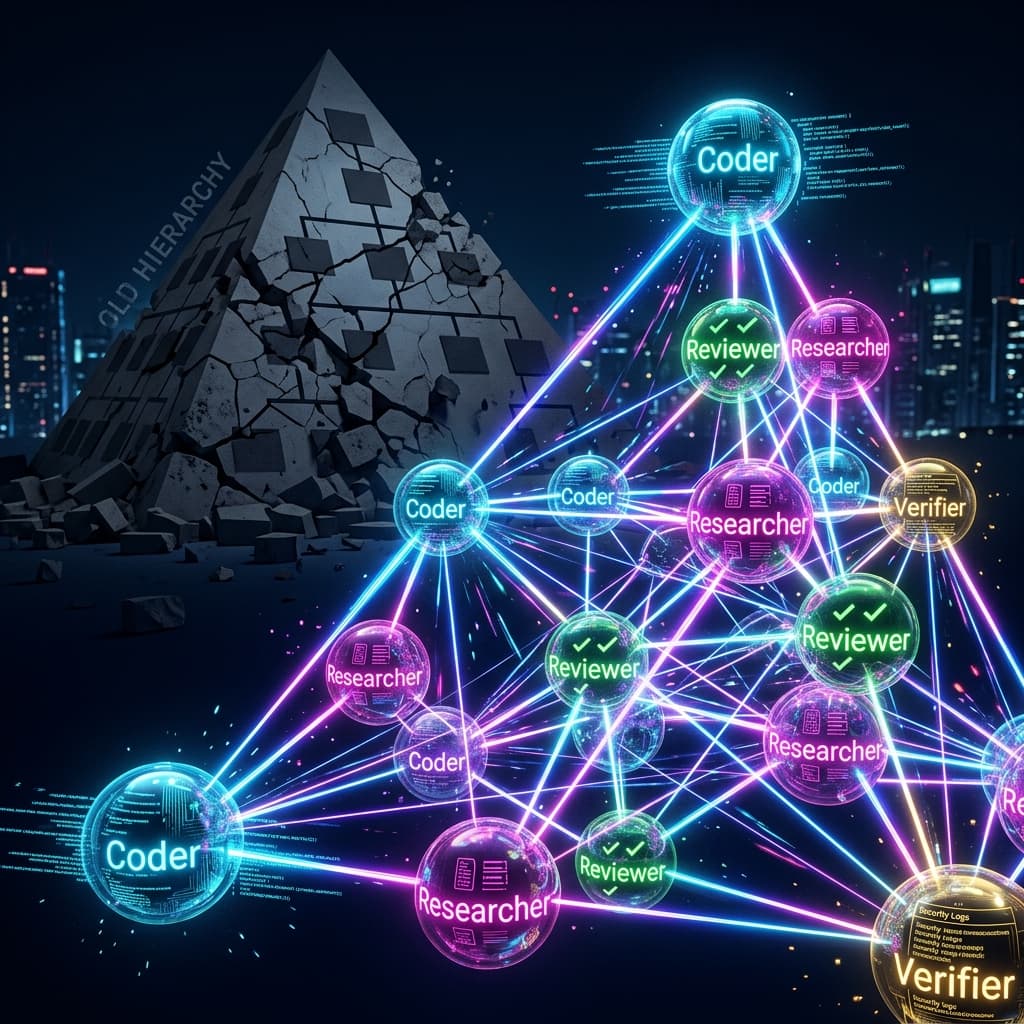
The Enterprise Agent Roadmap 2026: Multi-Agent Orchestration Patterns
Your vertical hierarchy is too slow for multi-agent systems. The Fractal Triad topology with LangGraph, CrewAI, and MCP integration for enterprise orchestration.
Read article