AI Doesn't Have To Be Soulless (And Here's How I Know)
TL;DR
A 15-year architect's turning point: how collaborative creation with AI revealed a path where technology amplifies human creativity, not replaces it.

Follow the turning-point story, then use the Creative Frequency Loop and journal prompts to guide your next creative session.
AI Doesn't Have To Be Soulless (And Here's How I Know)
A letter to my family, friends, and anyone who fears we're building a world without humanity.
TL;DR
After 15 years building enterprise AI systems, I felt empty—we optimized metrics while extracting meaning. Then Suno AI changed everything. I treated it as a collaborator, not a slot machine. 12,000+ songs later, I learned: AI doesn't have to be soulless if we design it to serve purpose. Everyone has a creative frequency. AI can amplify that frequency instead of masking it. The difference isn't the model—it's the intention you bring to the session.
The night the metrics broke me
It was 3:04 AM in an enterprise office, the kind of late-night glow where dashboards feel like constellations. I was shipping another system designed to optimize customer interactions at massive scale. The model hit every KPI. The rollout was a success.
But I felt empty.
I had spent 15 years architecting AI that could process billions of signals and still felt like it missed the point. We were extracting efficiency, but also extracting the soul out of the rooms those systems touched.
That night I wrote a question in my notebook that changed everything:
"What if our real goal is not to replace human creativity, but to amplify it?"
What soulless AI feels like
Soulless AI is not a technology problem. It is an intention problem. It feels like:
- Extraction over expression. Systems that turn people into data points instead of creative partners.
- Optimization without meaning. Metrics improve while energy and curiosity decline.
- Uniform outputs. Everything starts to sound the same, look the same, feel the same.
- Detached decisions. Automation that removes humans from the loop at the exact moment empathy matters most.
I was helping to build incredible systems. But the more powerful they became, the more I wanted to ask: Who is this actually for?
The Suno experiment that changed my mind
Three years ago I discovered Suno AI. I could have used it as a content slot machine, generating songs on repeat. Instead, I treated it like a collaborator.
I gave it a real emotion. A memory. A phrase from my journal. Then I listened.
The first song felt like a mirror. It was not me, but it reflected something in me. It invited me to respond.
12,000+ songs later, I learned something simple and radical:
Music is not just entertainment. It is creative technology.
AI did not replace my process. It accelerated it. It gave me a feedback loop where I could hear my inner life and refine it. That was the moment I realized the deeper truth: AI does not have to be soulless if we design it to serve purpose.
The Creative Frequency discovery
I call it Creative Frequency: your unique creative signature, the pattern that makes you unmistakably you.
What I learned through this process:
- Everyone has a creative frequency. It is buried under noise, not missing.
- AI can amplify that frequency. It does not have to mask it.
- Technology becomes purposeful when it serves human intention.
The Creative Frequency Loop (how I build with AI now)
This is the loop I use when I write, build, or compose with AI. It is the simplest system I know for keeping the work human.
- Listen. Start with a real feeling, memory, or tension. Write it down before you prompt.
- Translate. Convert the feeling into a prompt that preserves the emotion, not just the facts.
- Collaborate. Generate with AI, then respond as a human editor. Keep what resonates; discard what is empty.
- Refine. Iterate with tighter intent. Ask for more nuance, not more volume.
- Reflect. Journal what changed in you, not just what you produced.
A practical checklist for soulful systems
If you are building AI products, workflows, or content pipelines, ask these every time:
- Does this amplify human creativity or replace it?
- Does this connect people or isolate them?
- Does this help people feel seen or feel processed?
- Does the system invite authorship or just output?
- Does it reward care, or only speed?
If the answers point toward replacement, you are building a machine. If they point toward amplification, you are building a partner.
What this means for families, creators, and leaders
For families: teach kids that AI is a tool for imagination. Make it a co-creator, not a shortcut. Ask them to edit, remix, and reflect.
For creators: use AI to widen your palette, not to remove your voice. Treat every output as a draft you will sculpt by hand.
For leaders: design systems that surface human judgment, not suppress it. Make space for narrative, not just numbers.
A seven-day experiment to feel the difference
Day 1: Write a one-paragraph memory that still moves you. Day 2: Turn it into a prompt and generate three variations. Day 3: Edit one version until it feels honest. Day 4: Add a visual, melody, or symbol that deepens the feeling. Day 5: Share it with one person you trust. Day 6: Ask for the feeling it gave them, not their critique. Day 7: Write what you learned about your own voice.
The deeper takeaway
AI does not have to be soulless. It becomes soulless when we use it to avoid ourselves. It becomes soulful when we use it to return to ourselves.
The real work is not choosing between human and machine. The work is choosing intention. You can build systems that scale empathy, not just efficiency. You can design tools that make people more themselves, not less.
Your next step
If this resonates, I put the full framework into the Creative Frequency Framework, and the quickest way to get started is the Creative Frequency Quiz.
FAQ
What makes AI "soulless"?
Intent, not technology. Soulless AI extracts value instead of amplifying it. It optimizes metrics while draining meaning. It creates uniform outputs that feel disconnected from human experience. The model is neutral—how you use it determines the quality.
How do I know if I'm using AI with soul?
Ask yourself: Am I avoiding creative work or deepening it? Does the output feel like me or like noise? Am I iterating and refining or accepting first drafts? Purpose-driven AI use involves dialogue, not delegation.
Can enterprise AI be soulful?
Yes. The same architectural principles apply—surface human judgment, make space for empathy, design for meaning alongside metrics. Enterprise AI that supports decision-making rather than replacing it can be deeply soulful.
What if I'm not creative?
Everyone has a creative frequency. Buried under noise, not missing. The seven-day experiment in this article helps you find it. Start with a memory that moves you—that's the door.
How does this connect to your music?
12,000+ songs taught me that AI collaboration reveals what's already in you. Music became a feedback loop for understanding my own patterns. The same applies to writing, building, any creative work.
Related:
Build your first AI system
Step-by-step guide to setting up ACOS, creating your first agent, and shipping real products with AI.
Start buildingProduction-ready architecture
Download AI architecture templates, multi-agent blueprints, and prompt engineering patterns.
Browse templatesJoin the builder community
Connect with creators and architects shipping AI products. Weekly office hours, shared resources, direct access.
Join the circle
Read on FrankX.AI — AI Architecture, Music & Creator Intelligence
Stay in the intelligence loop
Weekly field notes on AI systems, production patterns, and builder strategy.
Continue Reading

ACOS v11: Visual Intelligence and Site Integrity — What Changed and Why
How 8 broken AI-generated images led to a 5-layer quality enforcement system, a 302-page site integrity audit, and a better way to create at scale.
Read article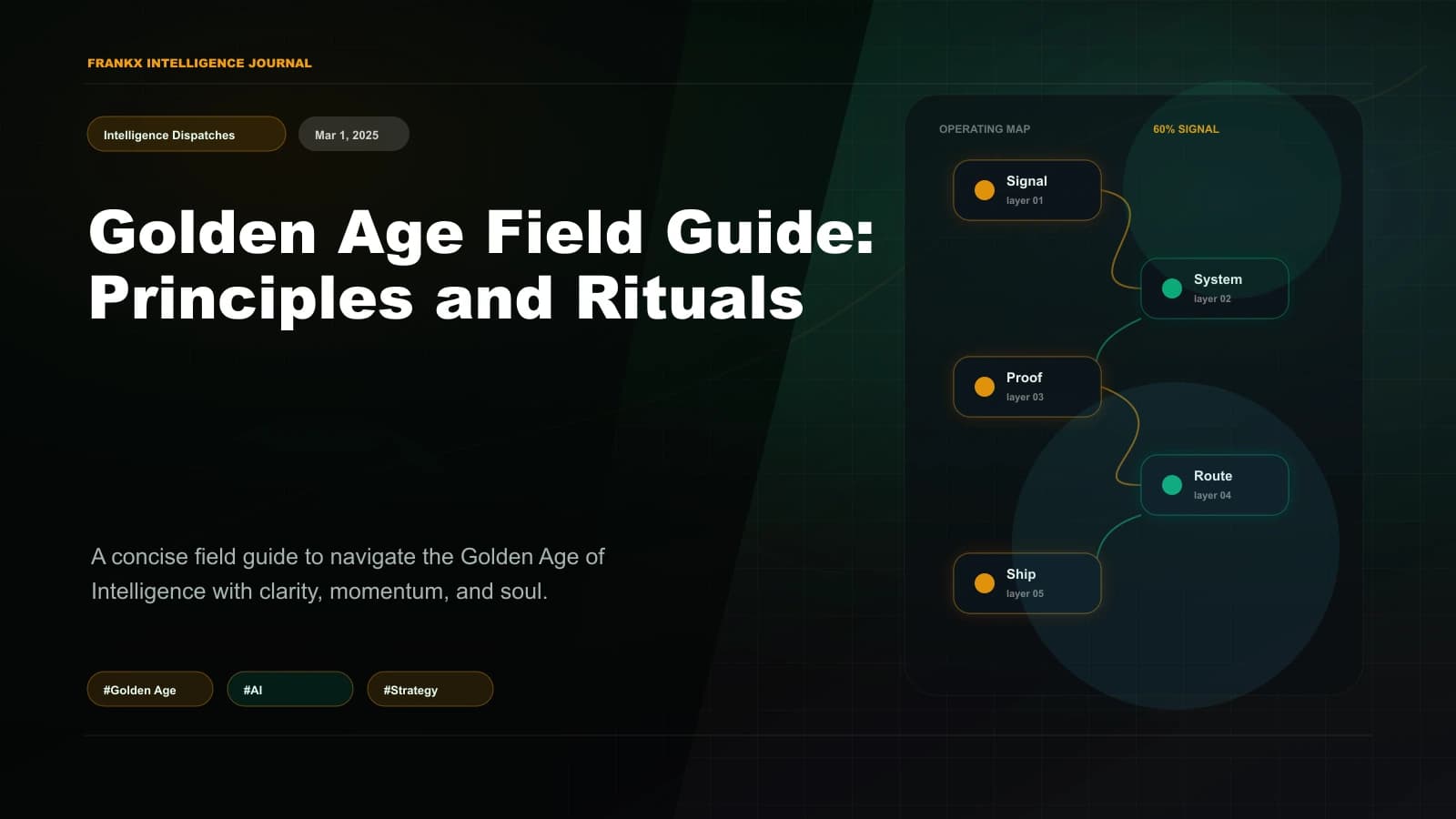
Golden Age Field Guide: Principles and Rituals
A concise field guide to navigate the Golden Age of Intelligence with clarity, momentum, and soul.
Read article
The Creative Frequency Framework
Everyone has a unique creative frequency — a way of expressing that's authentically yours. Here's how to discover yours and use AI to amplify it, not mask it.
Read article