The short answer
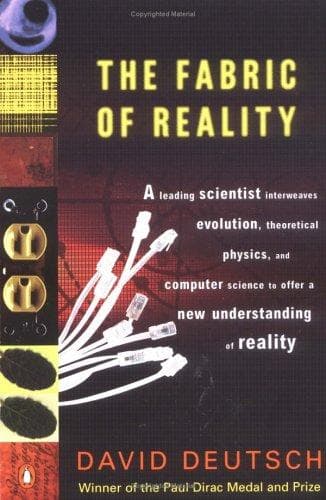
Deutsch argues that reality is best understood as the intersection of four strands — quantum physics (many-worlds), the theory of computation, epistemology (Popper), and evolution. Together they form a Theory of Everything in which the multiverse is literal, knowledge is physical, and problems are soluble.
Key Insights
- The four-strand explanation: reality is best understood as the intersection of quantum physics, the theory of computation, epistemology, and Darwinian evolution. No single strand is sufficient; none is fundamental above the others.
- The multiverse is not speculation — it is the most parsimonious reading of quantum mechanics. Parallel universes exist, and the interference pattern of the double-slit experiment is their signature.
- The Turing principle: a universal computer can simulate any physically possible process. This means reality itself is computable, and creativity is a physical phenomenon — not a metaphor.
- Knowledge is explanation, not prediction. Good explanations are hard to vary without losing their predictive power; that is the demarcation criterion, not Bayesian confidence or consensus.
- Problems are soluble. Pessimism about humanity's future mistakes the present for the permanent — any difficulty not forbidden by the laws of physics is, with enough knowledge, addressable.
Quotes Worth Remembering
16 recorded excerpts. Check the named edition and location before sharing the wording.
Problems are soluble.
Chapter 13 — The Four Strands
Deutsch's optimism is not a mood; it is a testable claim about the physics of knowledge. Any problem not forbidden by the laws of physics yields to enough knowledge.
Reality contains not only evidence, but also the means (such as our minds, and our artefacts) of understanding it. There are mathematical symbols in physical reality. The fact that it is usually we who put them there does not make them any less physical.
Chapter 10 — The Nature of Mathematics
The world is explicable. The universe, as well as being orderly, is comprehensible.
Chapter 1 — The Theory of Everything
A good explanation is hard to vary while still accounting for what it purports to account for.
Chapter 3 — Problem-Solving
This becomes the foundation of Deutsch's mature epistemology in The Beginning of Infinity.
If one is to understand reality, one has to ask what reality there is for good explanations to explain.
Chapter 4 — Criteria for Reality
The fabric of reality does not consist only of reductionist ingredients like space, time and subatomic particles, but also of life, thought, computation and the other things to which those explanations refer.
Chapter 1 — The Theory of Everything
Virtual reality is not just a technology in which computers simulate the behaviour of physical environments. The fact that virtual reality is possible is an important fact about the fabric of reality.
Chapter 5 — Virtual Reality
The physical universe, simple and orderly as it is, has within it the means of generating structures as complex as human beings. And it does so.
Chapter 8 — The Significance of Life
The laws of physics do not merely permit — they require — the universe to contain things that compute, evolve, and understand.
Chapter 13 — The Four Strands
Quantum computation is qualitatively new. It is not just faster classical computation; it uses a different part of physics.
Chapter 9 — Quantum Computers
To understand the multiverse, we have to accept that our snapshot of the universe at any given instant is, in effect, a snapshot of many universes.
Chapter 2 — Shadows
Science is an unending quest for better explanations.
Chapter 7 — A Conversation About Justification
What cannot be predicted in principle need not be doubted. What lacks explanation, however, is always open to question.
Chapter 3 — Problem-Solving
Deutsch's inversion of the positivist demand for predictive certainty — explanation, not prediction, is the marker of knowledge.
The growth of knowledge consists of finding errors in our existing theories and replacing them with better ones.
Chapter 3 — Problem-Solving
The existence of the multiverse is the best — in fact, the only — explanation of quantum phenomena.
Chapter 2 — Shadows
Pessimism is a theory. It can be true or false. And the evidence suggests that it is false.
Chapter 14 — The Ends of Universes
Deutsch concludes the book with an argument that human knowledge places no in-principle limits on the future — only on our current ignorance.
Chapter-by-Chapter
Each chapter carries a key idea and a short summary, so you can find the argument again.
01The Theory of Everything
A real Theory of Everything explains the structure of knowledge itself, not just the lowest-level particles.
OpenClose
Reductionism — the idea that truly understanding reality means reducing it to the smallest parts — is false. The genuine Theory of Everything must include physics, computation, epistemology, and evolution, because none of them is derivable from the others.
02Shadows
Interference patterns in the double-slit experiment are direct evidence of parallel universes.
OpenClose
Deutsch argues that "shadow photons" — particles that affect ours but never hit our detectors — are real. The simplest account is that they are photons from parallel universes leaking through. The multiverse is not interpretation; it is explanation.
03Problem-Solving
Knowledge grows by conjecture and criticism — not induction, not certainty.
OpenClose
Following Popper, Deutsch dismantles the idea that knowledge comes from accumulating observations. All observation is theory-laden. What counts is generating bold explanations and testing them hard. A good explanation is one that is hard to vary.
04Criteria for Reality
Something is real if our best explanations need it.
OpenClose
Dr Johnson kicked a stone to refute Berkeley. Deutsch generalises: a thing is real if postulating it yields explanations we would not otherwise have. By that standard, parallel universes, abstract numbers, and shadow photons all qualify.
05Virtual Reality
The possibility of universal virtual reality is a deep fact about physics.
OpenClose
A universal VR generator would be able to render any physically possible environment to the senses. The fact that the laws of physics allow such a device is not about technology — it is about the computational structure of reality itself.
06Universality and the Limits of Computation
The Turing principle: any physical process can in principle be simulated by a universal computer.
OpenClose
Deutsch upgrades Turing's thesis from a statement about logic to a statement about physics. The universe permits universal computation. This is why general-purpose intelligence, artificial or biological, is possible at all.
07A Conversation About Justification
Knowledge is justified by good explanation, not by authority or proof.
OpenClose
In a Socratic dialogue, Deutsch's "Crypto-Inductivist" and "Popperian" debate what makes scientific knowledge reliable. The conclusion: reliability comes from explanations that survive criticism, never from derivation from observation.
08The Significance of Life
Life and knowledge are not accidents — they are consequences of the way the laws of physics permit complexity.
OpenClose
Deutsch connects evolution to epistemology: genes are knowledge, embodied in a physical substrate. The capacity for life is written into the laws of physics, because those laws allow the growth of knowledge-embodying structures.
09Quantum Computers
Quantum computing is not just faster — it is physics recruiting parallel universes for computation.
OpenClose
Where classical computers manipulate bits, quantum computers manipulate interference across parallel universes. Deutsch's own 1985 paper on universal quantum computation sits behind this chapter; he argues the multiverse is not just ontology, it is the physical resource Shor's algorithm draws on.
10The Nature of Mathematics
Mathematical truths are discovered, not invented — but they live in physical reality.
OpenClose
Gödel, Turing, and Cantor showed mathematics is richer than any formal system. Deutsch argues mathematical objects exist because the universe contains minds and artefacts that embody them. Math is physical, but not reducible to physics.
11Time: The First Quantum Concept
Time is a dimension of the multiverse, not a flow — "now" is a set of parallel snapshots.
OpenClose
Deutsch rejects the conventional idea of time as a moving present. Different moments are different universes within the multiverse. What we experience as the passage of time is our brain's interpretation of the relationships between those snapshots.
12Time Travel
Time travel is permitted by physics — but it would be travel into other universes, not paradox.
OpenClose
Closed timelike curves in general relativity do not produce the grandfather paradox if the multiverse is taken seriously. The "traveller" arrives in a neighbouring universe where they change events; the universe they left remains unchanged.
13The Four Strands
Physics, computation, epistemology, and evolution are the unified theory of everything real.
OpenClose
The synthesis chapter: reality is best explained by weaving these four strands together. Each strand presupposes the others. This is Deutsch's central claim — and why the book is not a physics book, a philosophy book, or a CS book, but all three at once.
14The Ends of Universes
Given the laws of physics and the ability to create knowledge, there is no in-principle end to what minds can achieve.
OpenClose
Closing chapter: Deutsch speculates on the far future of the multiverse, the Omega Point, and the survival of knowledge beyond the heat death of individual universes. The final note is optimistic — problems are soluble.
Best For
Frequently Asked Questions
What are the four strands in The Fabric of Reality?
+
Quantum physics (specifically Everett's many-worlds interpretation), the theory of computation (Turing), epistemology (Popper's theory of knowledge), and Darwinian evolution. Deutsch argues each strand is necessary, and together they form a unified worldview.
Does Deutsch really believe in the multiverse?
+
Yes — literally. He treats parallel universes as the straightforward consequence of quantum mechanics taken at face value, without the philosophical add-ons of "wavefunction collapse" or Copenhagen-style interpretations. For Deutsch, interference is direct evidence of other universes acting on ours.
Is The Fabric of Reality a physics book or a philosophy book?
+
Both. It is physics in the sense that it takes quantum mechanics seriously as a description of reality, and philosophy in the sense that it argues for a specific epistemology (Popperian critical rationalism) as the right way to build knowledge. The argument is that you cannot have one without the other.
How does this book relate to AI and computation?
+
Deutsch's Turing principle — that a universal computer can simulate any physically possible process — grounds modern claims about general intelligence in physics rather than metaphor. If intelligence is a computational process and computation is physical, then creating AGI is a problem of knowledge, not of magic.
Should I read The Fabric of Reality or The Beginning of Infinity first?
+
The Fabric of Reality (1997) lays the foundation — the four strands, Popperian epistemology, the multiverse argument. The Beginning of Infinity (2011) builds on it with a more mature framework around "good explanations" and reaches further into ethics, creativity, and progress. Fabric of Reality first, Beginning of Infinity as the payoff.
Continue Reading
If The Fabric of Reality opened a door, these books walk you through it. Curated for reason, not algorithm — each entry explains why it pairs with this book.
The Beginning of Infinity
by David Deutsch
Deutsch's 2011 sequel. If The Fabric of Reality is the synthesis, Beginning of Infinity is the mature worldview — "good explanations", the reach of knowledge, and the ethics of progress.
Get the bookConjectures and Refutations
by Karl Popper
The source text for the epistemology strand. Deutsch is explicitly Popperian; this is where "problems are where theories and observations disagree" comes from.
Get the bookThe Logic of Scientific Discovery
by Karl Popper
Popper's foundational work on falsification and the demarcation problem. Denser than Conjectures and Refutations but more systematic.
Get the bookQED: The Strange Theory of Light and Matter
by Richard Feynman
The best popular account of quantum electrodynamics. Feynman's path-integral framing is a direct route into Deutsch's multiverse intuitions.
Get the bookOur Mathematical Universe
by Max Tegmark
A different multiverse architecture (Tegmark's four-level hierarchy). Reading it alongside Deutsch sharpens why Deutsch's version is specifically quantum-physical, not mathematical-platonic.
Get the bookThe Emperor's New Mind
by Roger Penrose
The opposing view. Penrose argues human consciousness is non-computable — which directly contradicts Deutsch's Turing principle. Reading both is the sharpest way to stress-test either.
Get the bookOn Computable Numbers, with an Application to the Entscheidungsproblem
by Alan Turing
The 1936 paper that invented the universal computer. Short, readable, and the direct ancestor of Deutsch's Turing principle.
Get the bookThe Selfish Gene
by Richard Dawkins
The evolutionary strand. Deutsch treats genes as physical embodiments of knowledge — Dawkins is where that framing starts.
Get the bookGo Deeper — Videos
A link marked YouTube search opens YouTube results. Any other link opens the page saved with this book.
David Deutsch — A new way to explain explanation
TED
Deutsch's canonical 16-minute talk. The "hard-to-vary" criterion for good explanations, distilled. Best single-video entry point to his worldview.
David Deutsch on the Lex Fridman Podcast
Lex Fridman
Long-form conversation covering constructor theory, the multiverse, AI, and the limits of knowledge. Deutsch in full flow.
David Deutsch — Constructor Theory of Life
The Royal Institution
Deutsch's later constructor-theory programme — the mature framework that extends Fabric of Reality's computational view into a full physics of possibility.
Naval Ravikant interviews David Deutsch
Naval
Naval's deep-dive with Deutsch on epistemology, optimism, and why "problems are soluble" is a physics claim, not a slogan.
Closer to Truth — David Deutsch on the Multiverse
Closer to Truth
Short, focused interviews with Deutsch on specific topics from the book — multiverse, quantum computation, the reality criterion. Good way to sample before committing to long-form.
If You Liked This, Read Ours
Our Book
Imagination
Unlocking the Power of the Mind
Your imagination is the most powerful technology you possess. This book teaches you how to wield it — creative visualization, mental models, and the architecture of thought.
Read freeThe FrankX Newsletter
One book breakdown like this. One spotlight from the operating loop. Every Friday.