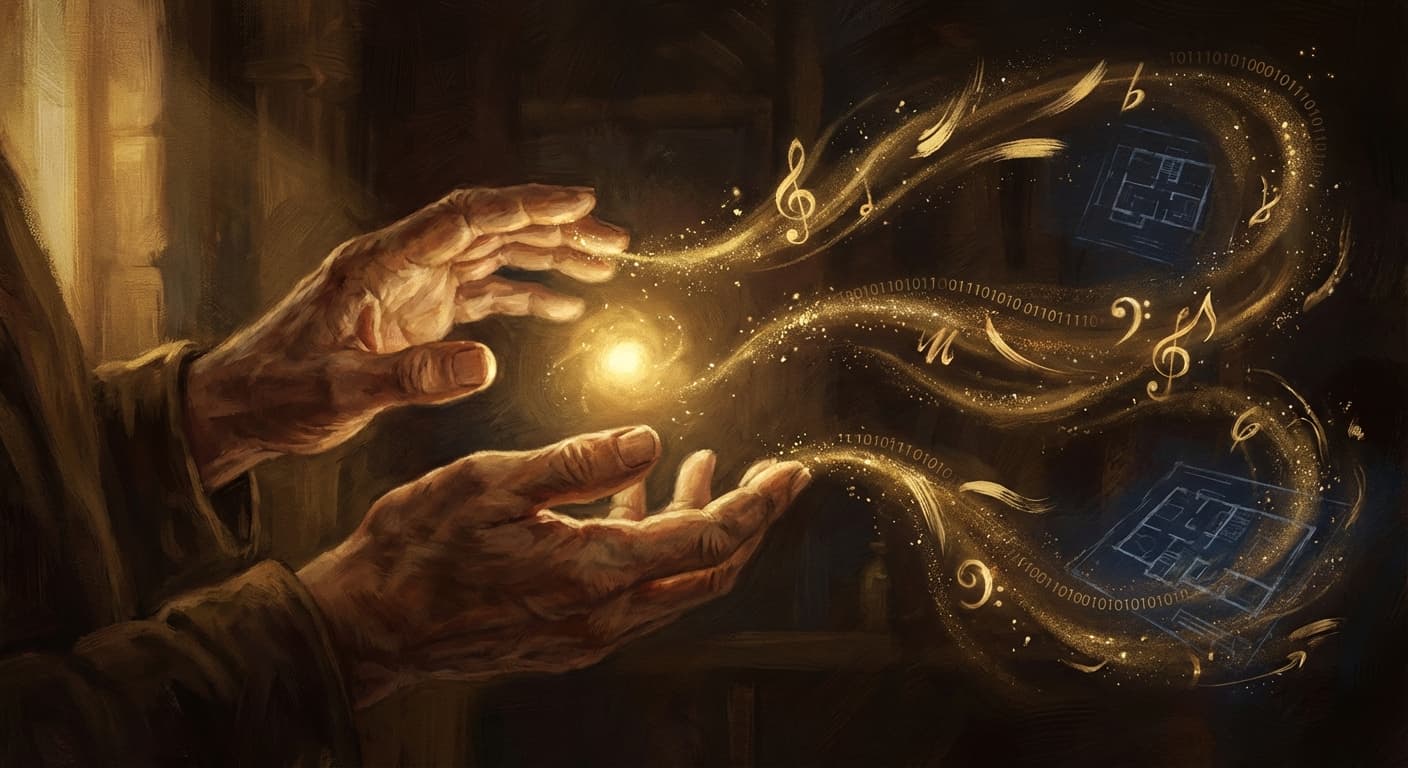
CHAPTER 3: THE FIRST GESTURE
"A journey of a thousand miles begins with a single step. A symphony begins with one lifted baton."
I.
The orchestra waits.
You have heard the call. You understand the age. You know what orchestration means, what it requires, what it makes possible.
And yet.
The baton remains on the stand. The first gesture—the one that transforms potential into motion, theory into music—has not been made.
This is where most creators live: in the space between understanding and doing. The gap feels small from a distance. From inside it, the gap is an ocean.
There is a particular form of paralysis that strikes those who see clearly.
You know too much to begin poorly. You understand enough to recognize the gap between where you are and where excellence lives. You have taste—and taste makes you aware of every way your first attempts will fall short.
Perfectionism is not the enemy of the good. Understanding is.
The amateur begins without hesitation because they do not know what good looks like. The master creates despite knowing exactly how far they have to travel. The person in between—the one who has glimpsed mastery but not yet walked its paths—often freezes.
You may be frozen.
Not from laziness. Not from lack of capability. But from the weight of seeing both the possibility and the distance.
II.
Here is what nobody tells you about first gestures:
They are supposed to be awkward.
Watch a conductor's first rehearsal with a new orchestra. The tempo wavers. The cues arrive slightly early or late. The musicians and maestro are learning each other's language, feeling for the shared rhythm that will later seem effortless.
The first rehearsal is not the concert. It is not supposed to be.
This is the permission most creators deny themselves: the permission to rehearse in public.
In the orchestration age, every creator who now operates with fluid mastery once produced work that embarrassed them. Every successful orchestration you admire began with fumbled prompts, miscoordinated agents, outputs that missed the vision by miles.
The difference between those who create and those who prepare to create is not talent. It is the willingness to make the first gesture knowing it will be imperfect.
Consider the evidence.
Research from 2026 shows that creators who launch projects within the first week of having an idea are four times more likely to complete them than those who spend a month preparing. The preparation itself becomes the work, consuming the energy that creation requires.
Meanwhile, no-code AI platforms have lowered the barrier to a first orchestrated creation to hours, not months. What once required engineering teams can now be wired together in an afternoon.
The tools are ready. The question is whether you are willing to make something that does not yet meet your standards.
III.
Strip the first gesture to its essence.
One workflow.
Not a full orchestration. Not your complete creative vision manifested at once. One workflow—a single process that currently requires your time and could be handled by coordinated AI agents.
Perhaps you spend four hours weekly researching topics for content. Perhaps you draft and redraft social posts that could be templated. Perhaps you manually transcribe calls, summarize meetings, follow up on leads.
Find the friction. The place where your creative energy drains into mechanical tasks. The work that must be done but does not require your irreplaceable judgment.
This is where orchestration begins.
One tool.
Not a suite of twelve platforms. Not every AI system you have bookmarked but never used. One tool, learned deeply enough to accomplish the single workflow you have chosen.
The 2026 landscape offers dozens of orchestration platforms. Some require code. Many do not. The functionality overlaps more than vendors admit.
What matters is not which tool you choose. What matters is choosing and beginning.
A creator who masters one orchestration platform can expand to others. A creator who researches all platforms without implementing any masters none.
One pilot period.
Thirty days.
Long enough to encounter the real challenges. Short enough to maintain focus. Bounded enough to have a completion point.
In thirty days, you will learn more about orchestration than in thirty months of preparation. The prompts that seem clear will reveal their ambiguity. The workflows that seem simple will expose their complexity. The outputs that seem automatic will require the judgment you thought you could delegate.
This is not failure. This is education.
The pilot exists not to prove that orchestration works—it works. The pilot exists to teach you how orchestration works for you, with your voice, toward your vision, in service of your particular contribution.
IV.
A practical pattern emerges from creators who have crossed the threshold.
Week One: Foundation
Choose the workflow. Select the tool. Define what success looks like—not in vague terms, but in specific metrics. "This process currently takes four hours per week. Success is reducing it to one hour while maintaining quality I would approve."
Build the first version of your orchestration. It will be crude. Expect this. The point is not perfection—the point is having something that runs.
Week Two: Iteration
Run the workflow repeatedly. Document what breaks. Notice where outputs miss your standards. Identify the prompts that need refinement, the handoffs that need adjustment, the quality checks that need addition.
This week reveals the gap between theory and practice. Every orchestration guide describes smooth workflows. Every actual workflow encounters friction. The friction is the teacher.
Week Three: Integration
Connect the orchestration to your actual work. Not as an experiment running parallel to your real process, but as a replacement for the old way.
This is the commitment that separates practice from performance. When the orchestration handles real stakes, you discover its true capabilities and limitations.
Week Four: Assessment
Measure what happened. Compare to the baseline you established. Not just time saved—though time matters—but quality maintained, energy preserved, creative capacity freed.
Some orchestrations will have worked better than expected. Some will need abandonment or fundamental redesign. Both outcomes are valuable. Both are data.
V.
Here is what successful first gestures share:
Ruthless simplicity.
The temptation is to orchestrate everything at once. To build the complete system that handles research and writing and design and distribution and analysis. To create on day one what others built over years.
This ambition, unchecked, produces nothing.
The creators who succeed start embarrassingly small. A single automated research process. A templated first draft that still requires heavy editing. A scheduling system that handles only one platform.
Small orchestrations that work teach more than grand orchestrations that don't.
Protected judgment.
The first gesture is not abandoning your standards. It is locating your standards in the right place.
Your judgment—your taste, your quality sense, your discernment—remains essential. But it shifts from execution to evaluation. You no longer do everything. You assess everything.
This is a different relationship to your own standards. Not lowering them. Relocating them.
Visible progress.
Choose first gestures that produce artifacts. Not just processes that run invisibly, but creations that emerge—drafts, designs, compilations, analyses.
When you can see what your orchestration produces, you can judge it. When you can judge it, you can improve it. When you can improve it, you develop the orchestration intelligence that distinguishes creators from tool collectors.
VI.
Fear has a particular voice. It sounds reasonable.
"I should understand more before I begin."
"I need better tools before this can work."
"The technology isn't quite ready for what I want to create."
"My situation is different. The standard approaches won't apply."
Each statement contains a grain of truth—and that grain is what makes fear persuasive.
But the accumulated weight of these reasonable concerns produces unreasonable outcomes. Another month passes. Another year. The tools improve while you watch them improve. Other creators produce while you prepare to produce.
The first gesture breaks the cycle.
Not because the concerns disappear. Because you move despite them. Because you value creation over certainty. Because you choose the awkward first attempt over the comfortable preparation.
There is a moment—perhaps you have felt it—when the decision crystallizes.
Not as emotion. Not as inspiration. As clarity.
You simply see: nothing will change until something changes. The orchestration you imagine will not arrive through more research. The creative contribution you carry will not emerge through better preparation.
The only path forward leads through the first gesture.
VII.
What happens after the first gesture?
The surprising answer: more first gestures.
Each completed orchestration reveals the next opportunity. Each workflow mastered exposes five workflows that could be transformed. Each capability developed suggests capabilities not yet imagined.
The first gesture is not the beginning of a journey with a fixed destination. It is the beginning of a practice without end.
Creators who thrive in the orchestration age are not those who built one perfect system and stopped. They are those who developed the habit of continuous beginning—each completion a platform for the next creation.
This is perhaps the deepest shift the first gesture enables.
Before you begin, orchestration is a concept you understand. After you begin, orchestration is a practice you inhabit.
The difference matters more than vocabulary can capture. It is the difference between knowing about swimming and swimming. Between reading about love and loving. Between studying music and making it.
Some things cannot be learned except through doing. Orchestration is one of them.
VIII.
Return, one final time, to the orchestra.
The hall has filled. The musicians have taken their places. The score is prepared, the instruments tuned, the lights dimmed to signal imminent beginning.
And now you stand at the podium.
Everything has led here. The call you heard. The orchestration you studied. The tools you gathered. The vision you carry.
The baton is in your hand.
What comes next is not a solo—you are not alone. The ensemble waits, capable of executing what they cannot envision. The audience waits, ready to receive what has not yet been created. The music waits, existing in potential, waiting for the gesture that summons it into being.
This is the moment.
Not tomorrow, when conditions improve.
Not next month, when tools are better.
Not next year, when you feel ready.
Now.
With whatever understanding you have, whatever tools you possess, whatever vision you carry—however incomplete, however imperfect, however far from the mastery you imagine.
The first gesture transforms everything that follows. The first gesture teaches what preparation cannot teach. The first gesture separates creators from those who plan to create someday.
Raise the baton.
Make the gesture.
Begin.
What was theory becomes practice.
What was potential becomes progress.
What was silence becomes the first note of a symphony no one but you can conduct.
END CHAPTER 3
Word Count: ~3,600
Quotable Passages
- "A journey of a thousand miles begins with a single step. A symphony begins with one lifted baton."
- "Perfectionism is not the enemy of the good. Understanding is."
- "The permission to rehearse in public."
- "The difference between those who create and those who prepare to create is not talent. It is the willingness to make the first gesture knowing it will be imperfect."
- "A creator who masters one orchestration platform can expand to others. A creator who researches all platforms without implementing any masters none."
- "Small orchestrations that work teach more than grand orchestrations that don't."
- "The first gesture breaks the cycle."
- "Some things cannot be learned except through doing. Orchestration is one of them."
- "What was theory becomes practice. What was potential becomes progress."